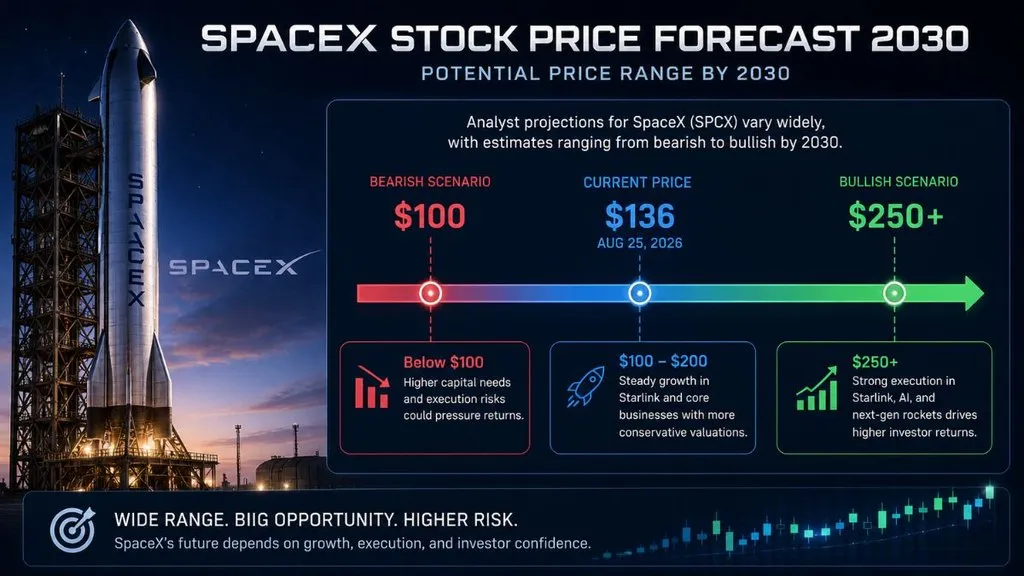
SpaceX stock has already given investors a reminder that big expectations can come with big swings. After going public at $135 a share, the stock climbed above $225 before falling below $105. As of Aug. 25, 2026, it was trading around $136, only slightly above its IPO price.
That volatility makes a SpaceX stock price forecast for 2030 difficult. There is a wide gap between the optimistic and cautious views of the company, and that gap may remain for years.
SpaceX stock price forecast for 2030
Recent estimates show just how uncertain the outlook is.
DZ Bank analyst Markus Leistner has valued SpaceX at about $100 per share, arguing that the company’s enormous future market opportunity may not justify the capital required to pursue it. At the other end, Oppenheimer analysts have put a $250 price target on the stock, based on SpaceX’s potential growth in AI infrastructure and other businesses.
The difference is significant. At $100, SpaceX would be below its IPO price. At $250, the stock would be worth considerably more than it is today.
For a simple 2030 range, that suggests investors could be looking at anything from well below $100 to $250 or higher, depending on how quickly the business expands and how much investors are willing to pay for that growth. Investors should also understand the basic principles behind evaluating risk and potential returns. Our guide, Investor Awareness Program explains some important rules that can help investors make more informed decisions.
Why the bullish case is so ambitious
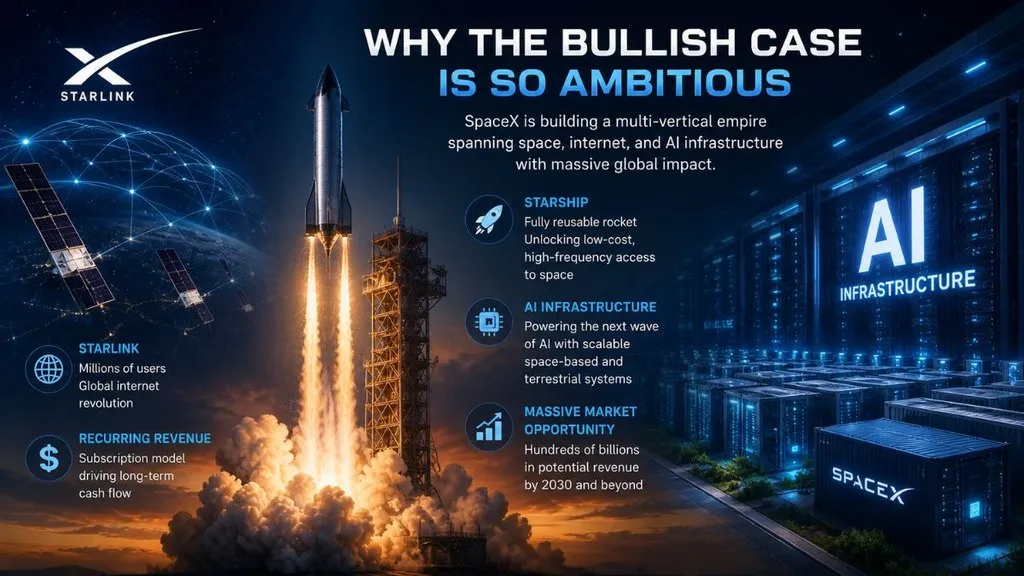
The biggest part of the SpaceX story is no longer just rockets.
Starlink has become an important source of the company’s growth, while SpaceX is also pursuing AI infrastructure and other technology opportunities. One bullish scenario cited by The Motley Fool sees revenue increasing from roughly $44 billion in 2026 to more than $760 billion by 2030.
But achieving that kind of growth would require enormous investment. Estimates cited in recent coverage put potential capital spending through 2030 at around $800 billion. Financing that expansion could mean significant borrowing or issuing additional shares, which could reduce existing shareholders’ ownership percentage.
That is an important part of the 2030 debate: strong revenue growth does not automatically translate into strong returns for shareholders.
The valuation problem
SpaceX’s current valuation is already extremely large. That means investors are not simply buying a traditional aerospace company and waiting for it to grow.
They are paying today for expectations about what SpaceX could become.
GuruFocus highlighted the growing disagreement among analysts, with the $100 DZ Bank valuation and $250 Oppenheimer estimate showing how differently Wall Street views the same company.
Meanwhile, another recent development could add more volatility. About 319 million SpaceX shares are being released as part of a staggered lockup process, giving some early investors and employees an opportunity to sell. Previous share unlocks did not automatically lead to a lasting decline, but additional supply can still influence the stock in the short term.
What could SpaceX stock be worth in 2030?
There probably isn’t a single number investors should treat as a reliable forecast.
A bearish scenario could put the stock below $100 if Starship, AI projects or other expansion plans require more money than expected while revenue growth disappoints.
A middle scenario could leave the shares somewhere around the $100-$200 range if Starlink and SpaceX’s core businesses continue growing but valuation multiples become more conservative.
A bullish scenario of $250 or higher would require SpaceX to execute exceptionally well, particularly in Starlink, AI infrastructure and its next-generation rocket ambitions. Oppenheimer’s $250 valuation provides one example of that more optimistic outlook. The most useful takeaway is not a precise 2030 price target. It is the unusually wide range of possible outcomes.
SpaceX has the opportunity to become much larger by 2030, but investors are also being asked to accept substantial execution, capital-spending and valuation risks along the way. For that reason, any SpaceX stock price forecast for 2030 should be viewed as a scenario rather than a promise.
What Could Drive SpaceX Higher?
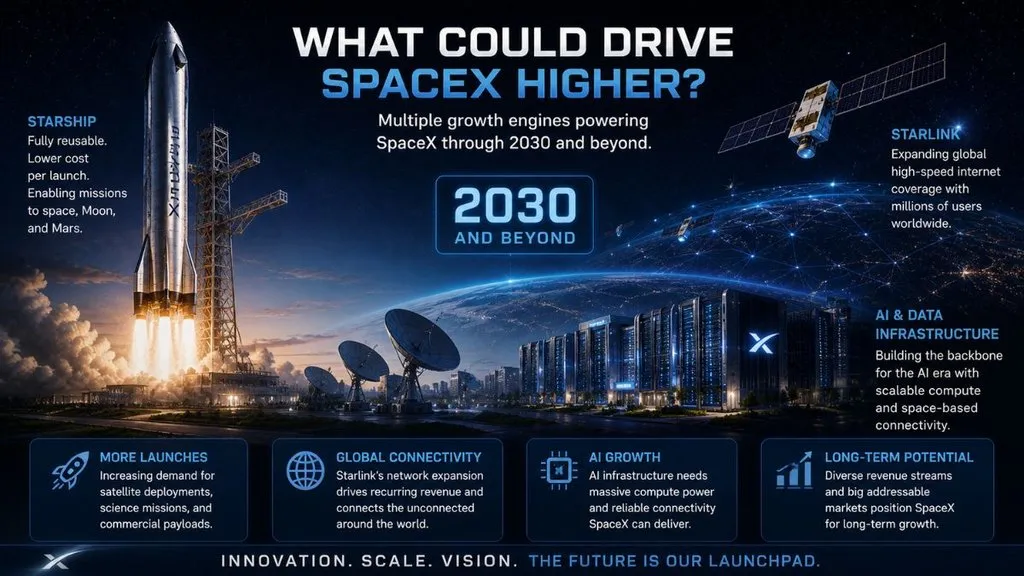
SpaceX could see strong growth by 2030 if Starlink continues adding customers and generating recurring revenue. Starship could also create new opportunities by making launches more frequent and potentially cheaper. The company’s interest in AI infrastructure adds another possible growth engine. Still, these projects require huge amounts of capital and face execution risks. That means SpaceX’s future stock price will depend not only on revenue growth, but also on spending, profitability and investor expectations. Any 2030 forecast should therefore be viewed as an estimate, not a guarantee. Learn more about the SpaceX Stock