If you are carrying balances on several credit cards, knowing the total amount you owe is only the beginning. A multiple credit card payoff calculator can turn those balances, interest rates, minimum payments, and your available extra cash into a practical repayment plan.
The basic idea is simple: enter the details for each card, choose or compare a repayment strategy, and see how your payment choices could affect your payoff timeline and interest costs. Tools such as Calculator.net and the USALearning Debt Destroyer Calculator use this approach to model multiple debts.
What Is a Multiple Credit Card Payoff Calculator?
A multiple credit card payoff calculator is a planning tool that estimates how long it may take to clear several credit-card balances and how much interest you may pay under different payment strategies.
Instead of looking at each card separately, the calculator puts your debts into one plan. You generally enter the current balance, APR, minimum payment, and the amount of money you can put toward debt each month.
For example, suppose you have three cards:
- Card A: $2,000 at 24% APR
- Card B: $4,000 at 18% APR
- Card C: $1,000 at 29% APR
You might owe $7,000 in total, but the three balances do not cost the same to carry. A calculator helps show how the order in which you attack them can change the overall repayment picture.
How Does the Calculator Work?
The process is straightforward. First, collect your latest account information. Then enter each debt separately rather than combining everything into one balance.
You will normally need:
- Current balance: How much you owe on each card.
- APR: The annual percentage rate used to calculate interest.
- Minimum payment: The required payment shown by the card issuer.
- Extra monthly amount: Money available beyond the required minimums.
Your total monthly debt budget matters because an extra $100 per month can produce a very different projection from an extra $500.
Calculators then estimate interest, payments, payoff periods, and—in some tools—the difference between repayment strategies. Calculator.net, for example, uses the debt avalanche approach for its multiple-card calculator, while USALearning provides minimum-payment, avalanche, and snowball comparisons.
Debt Avalanche vs. Debt Snowball
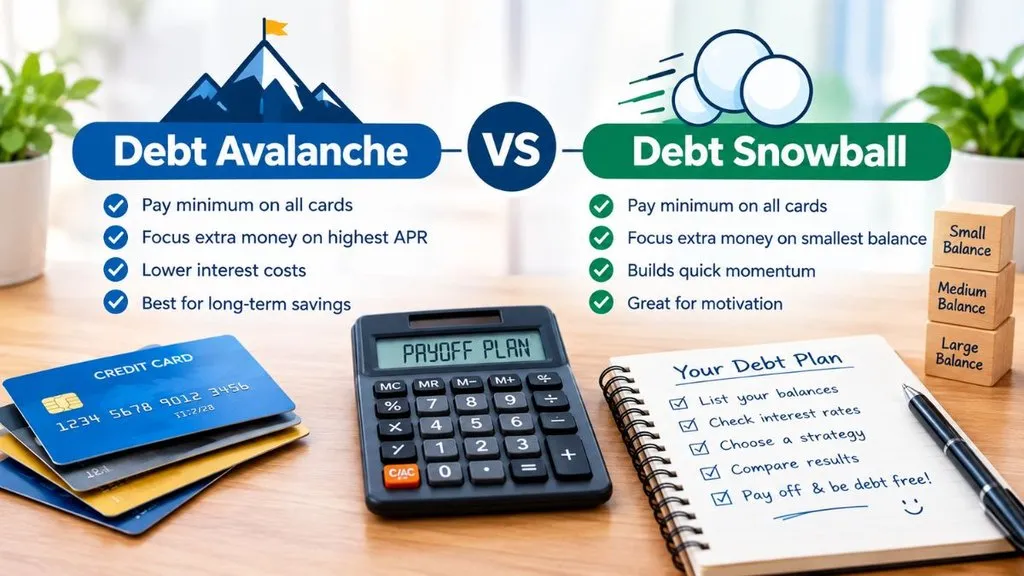
The two most common repayment approaches are the debt avalanche and debt snowball.
With the debt avalanche, you make the minimum payment on every card and direct your extra money toward the card with the highest APR. Once that balance is eliminated, the extra payment is redirected to the next highest-rate debt.
The goal is to reduce interest costs.
With the debt snowball, you still make the minimum payment on every card, but your extra money goes toward the smallest balance first. After that account is cleared, you roll its payment into the next-smallest balance.
The goal is to create visible progress and momentum.
A calculator is useful here because you do not have to rely on a general rule. You can enter your own balances and compare the projected results. The mathematical advantage of avalanche depends on the actual rates and balances, while the snowball may appeal to people who find quick account closures motivating.
What’s the Smartest Way to Pay Off Multiple Credit Cards?
There is no single strategy that is appropriate for every borrower. If your main objective is minimizing interest, compare the debt avalanche calculation with your actual APRs. If seeing smaller accounts disappear helps you maintain your repayment plan, the snowball may be easier for you to follow.
The key is to keep making at least the required payment on every account while directing your available extra money according to your chosen method.
For a simple hypothetical example, imagine that Card A has a $500 balance at 25%, Card B has $3,000 at 19%, and Card C has $5,000 at 15%. Snowball would target Card A first because it has the smallest balance. Avalanche would target Card A as well because it also has the highest APR.
In other situations, the two methods may produce different payoff orders. That is where a calculator becomes especially useful.
Is It Better to Pay Off One Credit Card or Pay Down Multiple Cards?
If you have multiple revolving balances, you generally need to keep all accounts current while concentrating additional money on a target account. That means you are technically paying multiple cards, but your extra payment is focused on one debt at a time.
Paying only a little extra toward every card can spread your available money thinly. A targeted approach makes it easier to see which balance should receive the next dollar.
Once a card reaches zero, its former payment can be added to the amount directed toward the next target. This is sometimes called a payment rollover or “roll-up.”
Can You Build a Multiple Credit Card Payoff Calculator in Excel?
Yes. A multiple credit card payoff calculator Excel spreadsheet can give you more control over the assumptions and let you track actual payments over time.
A basic spreadsheet can include columns for:
| Card | Balance | APR | Minimum Payment | Extra Payment | Priority |
| Card A | $2,000 | 24% | $60 | $200 | 2 |
| Card B | $4,000 | 18% | $100 | $0 | 3 |
| Card C | $1,000 | 29% | $30 | $0 | 1 |
You can then create a monthly schedule showing the opening balance, interest, payment, and closing balance.
ExcelDemy demonstrates how a spreadsheet can be built around payment formulas and amortization calculations for multiple debts.
A spreadsheet is particularly useful if you want to change your extra payment, compare snowball and avalanche, or record what you actually paid rather than relying only on an initial projection.
What Is the 15-3 Rule on Credit Cards?
The “15-3 rule” refers to advice to make one credit-card payment 15 days before the statement closing date and another three days before it. However, there is no special credit-scoring formula that makes those exact two dates inherently better.
What can matter is the balance reported to the credit bureaus and your overall credit utilization. Paying down a balance before the statement closes may affect the balance reported, but the specific 15-and-3 schedule is not a guaranteed credit-score strategy. Current consumer-finance reporting describes the precise timing as a popular but unsupported “hack.”
For debt payoff, the more important question is how much you can consistently pay and how quickly your balances decline.
When Should You Consider Consolidation?
Debt consolidation combines multiple debts into one new payment, potentially through a personal loan or another financial product. A balance-transfer credit card may also allow eligible borrowers to move balances under promotional terms.
The appeal is simplicity and, in some cases, a lower interest rate. But consolidation does not automatically reduce debt. You need to compare the new interest rate, fees, promotional period, repayment term, and total cost.
A lower monthly payment can also result from extending the repayment period, so look at total interest rather than payment size alone. Most importantly, avoid assuming that moving balances eliminates the underlying spending or budgeting problem.
What a Payoff Calculator Cannot Tell You
Calculator results are estimates, not promises. Actual credit-card interest and minimum payments can vary according to issuer terms, transaction timing, fees, changing rates, and other account conditions.
Some calculators also make simplifying assumptions. For example, USALearning notes that its calculator has a maximum of 360 payments and warns that insufficient payments can allow a balance to continue growing.
Before acting on a projected payoff date, compare the assumptions with your actual card agreements.
Also remember that a calculator cannot decide how much money you should keep for emergencies or whether consolidation makes sense for your circumstances. It is a planning aid, not personalized financial advice.
Common Mistakes to Avoid
One common mistake is entering outdated balances or APRs. Start with current statements so your calculation has useful inputs.
Another is forgetting minimum payments when calculating the extra amount. Your “extra” debt budget should normally be money available after accounting for required payments.
Finally, do not treat the projected debt-free date as fixed. If you use the cards again, miss payments, change your monthly budget, or experience a rate change, the plan can change too.
The most useful approach is to revisit your calculator or spreadsheet periodically and update it with actual balances and payments.
Frequently Asked Questions
How does a multiple credit card payoff calculator work with multiple balances?
It combines each card’s balance, APR, and payment information into a repayment model. Depending on the tool, it can estimate payoff dates, interest costs, and the effect of strategies such as avalanche or snowball.
How much extra should I pay toward my credit cards?
There is no universal amount. Start with the amount that your budget can consistently support after required payments and essential expenses. Even a modest additional payment can change the repayment timeline, but the exact effect depends on your balances and interest rates.
Can I pay off my credit card multiple times in one month?
Yes, many issuers allow multiple payments during a billing cycle, subject to their payment policies. Multiple payments can help with cash-flow management or reduce a balance earlier, but simply splitting a payment does not automatically produce a special interest or credit-score benefit.
Should I use an Excel spreadsheet or an online calculator?
An online calculator is convenient for quickly comparing scenarios. A spreadsheet can be better for detailed tracking, customization, and recording your actual monthly progress.
Does paying more than the minimum always reduce interest?
Paying more toward a revolving credit-card balance generally reduces the balance on which future interest can accrue, assuming the payment is properly applied to the account. Your exact savings depend on the card’s terms, rate, balance, and payment timing.