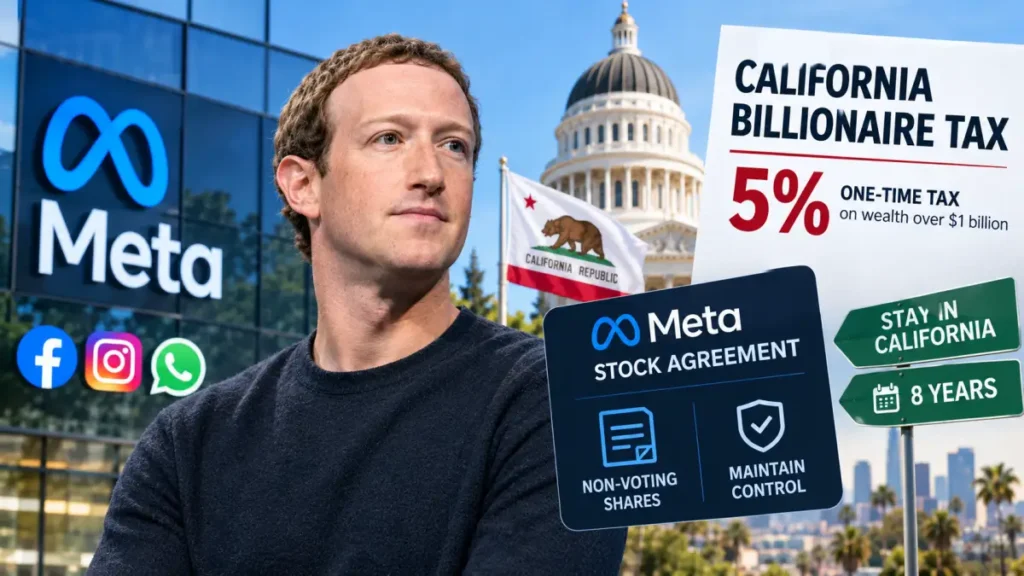
Mark Zuckerberg has reached a deal with Meta to help him pay a potential California billionaire tax without losing control of the company he founded. The agreement allows him to sell some newly issued non-voting shares while committing to remain in California for eight years, subject to certain exceptions. Source: Reuters via Yahoo Finance.
Meta’s AI investments reflect a broader trend in tech, similar to Tesla’s market outlook. Read our analysis of Tesla (TSLA) earnings and the expected stock move for more insights.
Why Did Mark Zuckerberg Make a Deal With Meta?
Meta CEO Mark Zuckerberg has reached an agreement with the company’s board amid concerns about a proposed wealth tax in California. The proposal, known as Proposition 40, would introduce a one-time 5% tax on the wealth of eligible California residents worth more than $1 billion if voters approve it.
Zuckerberg’s fortune is largely tied to his ownership of Meta, the parent company of Facebook, Instagram, and WhatsApp. Because much of his wealth exists in company shares rather than cash, paying a tax worth billions of dollars could require him to sell some of his holdings.
However, selling certain shares could also affect his voting power at Meta. The new agreement is designed to give him greater financial flexibility while helping him maintain control of the technology company.
According to Associated Press reporting published by ETTelecom, the arrangement followed discussions in which Zuckerberg considered relocating from California over concerns about the proposed tax.
What Is the California Billionaire Tax Proposal?
The proposed California wealth tax has become a major talking point among technology executives, investors, and policymakers.
Under the measure, eligible billionaires who meet the residency requirements could face a one-time tax of 5% on their wealth. The proposal is intended to raise money for public services, including healthcare, education, and food assistance.
Supporters argue that wealthy individuals should contribute more toward public services, particularly when their fortunes have grown substantially through investments. They believe the tax could provide additional funding for essential programs.
Opponents, however, warn that the measure could encourage wealthy residents to move elsewhere. They also question whether a tax on wealth could create financial uncertainty for business owners whose assets are tied up in company shares.
The proposal is not yet an enacted tax. California voters are expected to decide its fate in November 2026, making the outcome important for both wealthy residents and the state’s wider business community.
How Will Meta’s New Stock Deal Work?
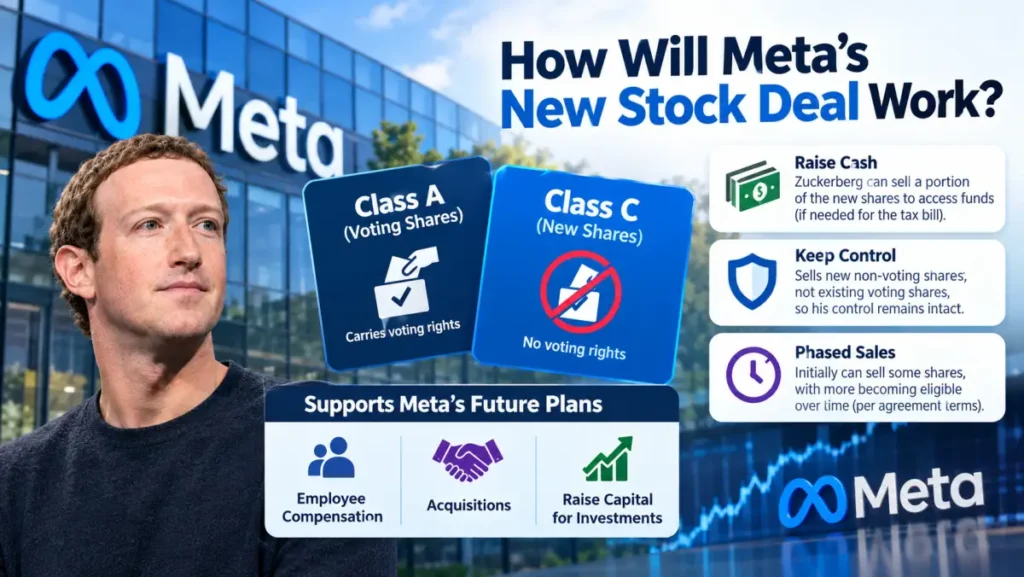
Meta’s agreement with Zuckerberg involves creating a new class of shares known as Class C common stock. Unlike the company’s voting shares, these shares do not carry voting rights.
This distinction is important because it could allow Zuckerberg to sell some of his new shares to raise cash without directly reducing his voting control through the sale of existing voting shares.
Under the reported arrangement, Zuckerberg will initially be able to sell a portion of the new shares, with additional shares becoming eligible for sale over time under the agreement’s conditions.
The structure is designed to address two concerns at once: helping Zuckerberg access funds if he faces a substantial tax bill and allowing him to remain closely involved in Meta’s leadership.
Meta has also said the new share class could support other corporate needs, including employee compensation, acquisitions, and raising capital for future investments.
Why Does Meta Want Zuckerberg to Stay in California?
Zuckerberg has led Meta through major changes in the technology industry, from the growth of Facebook to the expansion of Instagram and WhatsApp. More recently, the company has increased its focus on artificial intelligence.
Meta’s board considers Zuckerberg’s continued leadership important as competition in AI intensifies. Developing AI models, building data centres, and acquiring computing infrastructure require substantial investment and long-term planning.
Keeping its chief executive near the company’s California headquarters may also help with leadership coordination and strategic decision-making.
The agreement therefore goes beyond Zuckerberg’s personal tax concerns. It reflects Meta’s interest in maintaining stable leadership while the company competes with other major technology firms in a rapidly changing market.
Could the Deal Affect Meta’s Shareholders?
The agreement could have implications for investors because it changes how Meta manages its shares and provides its leadership with additional financial flexibility.
For Zuckerberg, the central benefit is the potential to raise cash without sacrificing the same level of voting control that a sale of voting shares might threaten.
For Meta, the new share structure offers additional options for financing growth, compensating employees, and pursuing acquisitions. These options could become particularly relevant as the company expands its AI infrastructure.
However, investors will still need to consider the costs and implications of the arrangement. The value of any shares Zuckerberg sells will depend on Meta’s market price, and the final tax consequences will depend on the proposal’s outcome and applicable rules.
The agreement does not eliminate all uncertainty surrounding Meta’s finances or the proposed California tax. Explore how AI is transforming financial markets in our article on Leverate’s MCP launch for traders, highlighting new tools for smarter trading.
What Happens Next for Mark Zuckerberg and Meta?
The next major development will be the California vote on the proposed billionaire tax. If the measure passes, Zuckerberg could face a substantial tax obligation, although the final amount would depend on the applicable assessment rules.
Meta’s stock agreement is intended to provide a way to manage that possibility while preserving Zuckerberg’s leadership role. If voters reject the proposal, the tax-related pressure could change, but the new share structure may still serve Meta’s broader business purposes.
The situation also highlights a wider question facing technology companies: how to balance founder control, shareholder interests, public policy, and the enormous cost of developing new technology.
Final Thoughts
The Mark Zuckerberg and Meta deal shows how a proposed wealth tax can influence decisions at one of the world’s largest technology companies. By arranging access to non-voting shares and committing to remain in California for eight years, Zuckerberg has secured a potential way to meet future financial obligations without directly giving up his existing voting control.
The ultimate impact will depend on California’s decision, the value of Meta’s shares, and how the company uses its new stock structure. For now, the agreement is both a response to a possible tax bill and a strategic move as Meta continues investing heavily in artificial intelligence.