Chip stocks tumbled sharply as renewed concerns about artificial intelligence spending, supply-chain constraints, and company earnings weakened investor confidence. The latest sell-off shows that strong demand for AI chips alone may not be enough to keep semiconductor shares rising.

Why Are Chip Stocks Tumbling?
Chip stocks came under pressure as investors reconsidered the outlook for the semiconductor industry and the enormous investments supporting the AI boom. According to Investopedia’s market update, semiconductor shares declined amid concerns about the sustainability of AI spending and rising geopolitical tensions.
The market reaction also highlighted a growing concern: investors want more than strong revenue figures. They want evidence that companies can turn heavy investment in artificial intelligence into sustainable profits.
When expectations are high, even earnings that meet forecasts may disappoint investors. This helps explain why semiconductor stocks can fall even when their underlying businesses continue to grow.
Understanding market movements also requires financial knowledge and informed decision-making. Investors can improve their understanding of market risks and investment decisions by learning more about the investor awareness program and its meaning.
AI Spending Concerns Weigh on Semiconductor Stocks
Artificial intelligence has become a major growth driver for chipmakers. Data centers require powerful processors, memory chips, networking equipment, and advanced semiconductor manufacturing technology.
However, building AI infrastructure requires enormous capital investment. Investors are increasingly questioning whether technology companies will generate enough revenue and profit to justify their spending.
These concerns can affect the entire semiconductor sector. If cloud providers slow their spending or become more selective about infrastructure projects, demand expectations could weaken across several parts of the supply chain.
A report from Investing.com described declines across US and European chip stocks as worries about the sustainability of AI investment spread through global markets.
The concern is not necessarily that AI demand will disappear. Instead, investors are trying to determine whether current valuations already reflect too much future growth.
Lam Research Stock Falls as Investors Assess Its Outlook
Lam Research has been one of the important companies to watch during the recent semiconductor sell-off. The company supplies equipment used to manufacture advanced chips, making its business closely connected to semiconductor industry investment.
According to Investopedia’s report, Lam Research shares fell nearly 9% during premarket trading after its outlook failed to exceed elevated market expectations.
This reaction illustrates how sensitive semiconductor equipment stocks can be to future guidance. Even when a company reports solid results, investors may sell if management’s outlook does not suggest stronger-than-expected growth.
Supply-chain constraints can create another challenge. Manufacturing equipment companies depend on specialized components, suppliers, and complex production schedules. Delays can affect deliveries and the timing of revenue.
Investors can read more about these concerns in Yahoo Finance’s report on Lam Research and supply-chain constraints.

Nvidia and Other Chip Stocks Face Market Pressure
Nvidia remains a key company to watch because its graphics processing units are widely used in AI computing. However, its shares can still decline when investors become cautious about technology valuations, spending plans, or broader market conditions.
The recent weakness has extended beyond individual chipmakers. Semiconductor equipment suppliers, memory manufacturers, and other technology companies have also faced selling pressure.
The iShares Semiconductor ETF (SOXX), which tracks a group of semiconductor-related stocks, fell more than 3% during the session described by Investopedia. This broad decline suggests that investor concerns were affecting the sector rather than just one company.
For investors, the distinction matters. A company-specific problem may have a limited impact, while sector-wide selling can reflect changing expectations about growth, valuations, and future demand.
Learn how Nvidia earnings influence NVDA stock, AI demand, investor confidence, and the broader semiconductor market.
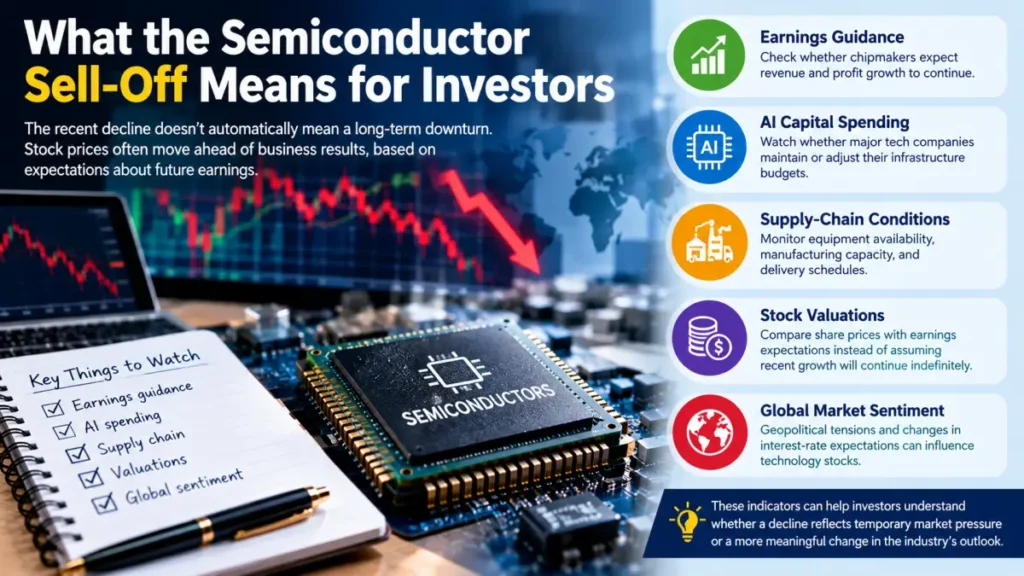
What the Semiconductor Sell-Off Means for Investors
The latest decline does not automatically mean the semiconductor industry has entered a prolonged downturn. Stock prices often move ahead of business results, reflecting expectations about future earnings rather than current performance alone.
Investors should pay attention to several factors:
- Earnings guidance: Check whether chipmakers expect revenue and profit growth to continue.
- AI capital spending: Watch whether major technology companies maintain or adjust their infrastructure budgets.
- Supply-chain conditions: Monitor equipment availability, manufacturing capacity, and delivery schedules.
- Stock valuations: Compare share prices with earnings expectations instead of assuming recent growth will continue indefinitely.
- Global market sentiment: Geopolitical tensions and changes in interest-rate expectations can influence technology stocks.
These indicators can help investors understand whether a decline reflects temporary market pressure or a more meaningful change in the industry’s outlook.
Can Chip Stocks Recover After the Sell-Off?
A recovery is possible if companies deliver stronger earnings, AI investment remains resilient, and investors regain confidence in semiconductor valuations. However, a short-term rebound would not necessarily confirm that the market has returned to a sustained upward trend.
A Yahoo Finance analysis of semiconductor stocks and key market levels discusses the importance of price levels in assessing whether a recovery can hold.
Investors should avoid treating a single positive trading session as proof that selling pressure has ended. Consistent earnings performance, credible company guidance, and improving market sentiment would provide stronger evidence of a durable recovery.
Final Thoughts
Chip stocks tumble, crushing investor hopes for a sustained rebound, as concerns about AI spending, company guidance, and supply-chain challenges put pressure on semiconductor shares.
The recent weakness highlights the difference between a promising industry and an attractive stock valuation. Artificial intelligence may continue creating opportunities for chipmakers, but investors will likely demand clearer evidence of sustainable growth and profitability.
For now, earnings expectations, AI investment trends, and broader market conditions remain important factors to watch as semiconductor stocks search for a more stable direction.
Pingback: European Stocks Could Outperform Wall Street as AI Trade Slows
Pingback: Mitsui Chemicals JSR Acquisition: $11.6 Billion Deal Explained