Bank communication management is the process of controlling how a company sends payments to banks, receives bank messages and statements, approves transactions, and monitors what happens after a payment leaves the ERP system. In an SAP environment, SAP Bank Communication Management (BCM) provides a structured layer for payment batching, approvals, payment-status monitoring, bank-statement monitoring, and bank connectivity.
For finance teams, the value is bigger than simply “sending payment files.” A properly designed BCM process can reduce manual handling, strengthen segregation of duties, create an audit trail, and give treasury teams better visibility into payment exceptions. This guide explains how bank communication management SAP capabilities work, where SAP BCM fits with Multi-Bank Connectivity, what companies should configure, and where the technology does—and does not—reduce payment risk.
What Is Bank Communication Management?
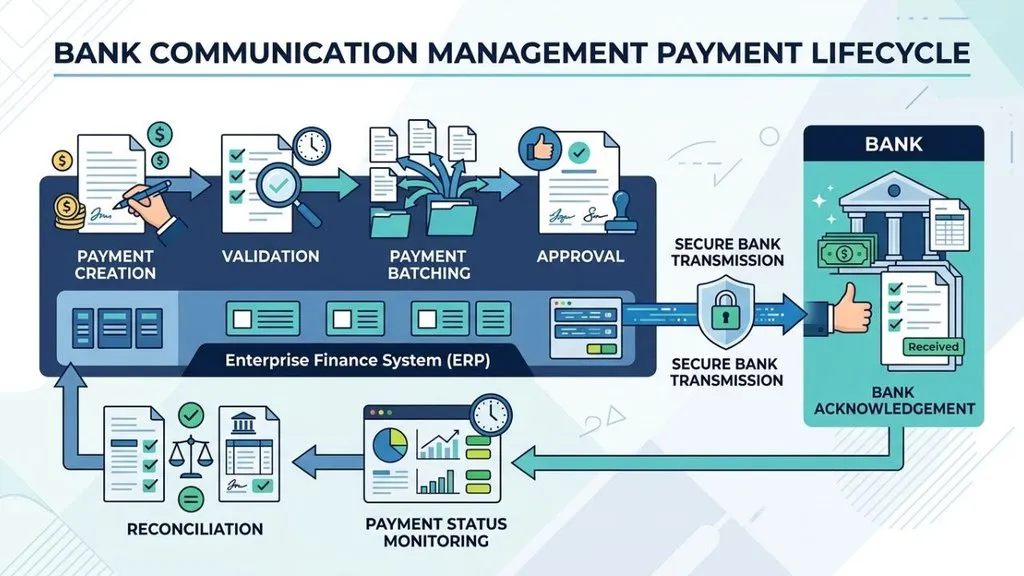
Bank Communication Management is a financial-process framework for controlling and monitoring communications between an organization’s ERP system and its banks. In SAP, BCM can group outgoing payments into batches, route them through approval workflows, monitor payment statuses, process bank statements, and maintain visibility over the payment lifecycle.
The simplest way to think about it is:
Payment creation → validation → grouping → approval → bank transmission → bank response → status monitoring → reconciliation.
BCM does not replace the bank. It acts as an important control and orchestration layer between payment processes inside SAP and the external banking environment.
How Does SAP Bank Communication Management Work?
SAP BCM sits within SAP’s financial processes and helps control what happens to payment media before and after communication with banks. Depending on the architecture, outgoing messages can be sent through a file-based channel or through SAP Multi-Bank Connectivity, while incoming messages such as payment-status reports and bank statements can be processed back into SAP.
A typical process looks like this:
- A payment run creates proposed payments.
- BCM groups eligible payments into batches according to configured rules.
- Approvers review the batch based on the company’s authorization policy.
- Approved payment media are generated or released for transmission.
- The banking channel sends the message to the relevant bank.
- The bank returns acknowledgements, status messages or statements.
- SAP processes those responses so finance teams can identify accepted, rejected, pending or exceptional transactions.
SAP documentation specifically describes BCM as supporting payment batching, multiple approval levels, payment-flow transparency, payment-status monitoring and bank-statement monitoring.
That distinction matters. A payment file being successfully transmitted does not necessarily mean the bank has successfully processed every payment inside it. For readers looking to better understand insurance options and coverage, our guide to Fail a Conventional Loan explains what brokers do and what to consider when comparing policies.
Why Does Bank Communication Management Matter?
The biggest benefit of bank communication management is control over the gap between creating a payment and knowing what happened to it.
Without a centralized process, large companies may have payment files, bank portals, email notifications, spreadsheets and ERP records scattered across different teams. That makes it harder to answer basic questions:
- Who approved this payment?
- Was the file actually sent?
- Did the bank acknowledge it?
- Was an individual payment rejected?
- Which bank account received the money?
- Is the bank statement available?
- Has the transaction been reconciled?
- Did a payment remain unacknowledged longer than expected?
BCM addresses these questions through centralized monitoring and workflow capabilities. SAP also provides alert functionality for events such as unacknowledged payments and batch-status timeouts.
For a multinational organization, this becomes particularly useful when dozens or hundreds of bank accounts and multiple banking partners are involved. Learan more about banking read now.
What Are the Main Features of SAP BCM?
SAP Bank Communication Management provides several functions that are easy to confuse with broader treasury or banking software.
Payment batching
BCM can logically structure payments into batches. Companies can establish grouping rules based on payment characteristics and business requirements.
For example, a company could have separate approval treatment for:
- High-value payments
- Domestic payments
- International payments
- Different company codes
- Different currencies
- Particular payment methods
The exact design depends on the organization’s authorization policy and SAP configuration.
Payment approval and dual control
BCM can support multiple approval levels and the so-called four-eyes principle, meaning a payment can require review by another authorized person before release. SAP states that the four-eyes principle can be applied to bank payments through BCM, although its use is not mandatory.
Digital signatures can also be used within release workflows. SAP documentation says the payment medium is generated only after the configured approval steps have been successfully completed. This is particularly important for organizations trying to separate payment preparation from payment authorization.
Payment status monitoring
A payment can have several stages after it leaves the ERP system. BCM provides a payment-status monitor that can receive status messages from banks and SWIFT-related processes.
That gives treasury and accounts-payable teams a better opportunity to investigate exceptions rather than assuming every transmitted file succeeded.
Bank statement monitoring
Bank statements can be brought into the SAP environment and processed as part of the broader financial workflow.
SAP’s current documentation lists several statement formats and message types that can be processed through the Multi-Bank Connectivity connector, including CAMT statement messages and traditional formats such as MT940 and MT942 in supported scenarios.
Alerts and exception handling
BCM can be configured for alerts around payment events, including rejected payments and missing acknowledgements. Timeout monitoring can identify situations where an expected batch update has not arrived within the configured period.
That turns bank communication from a passive file-transfer process into an exception-management process.
Is SAP BCM the Same as SAP Multi-Bank Connectivity?
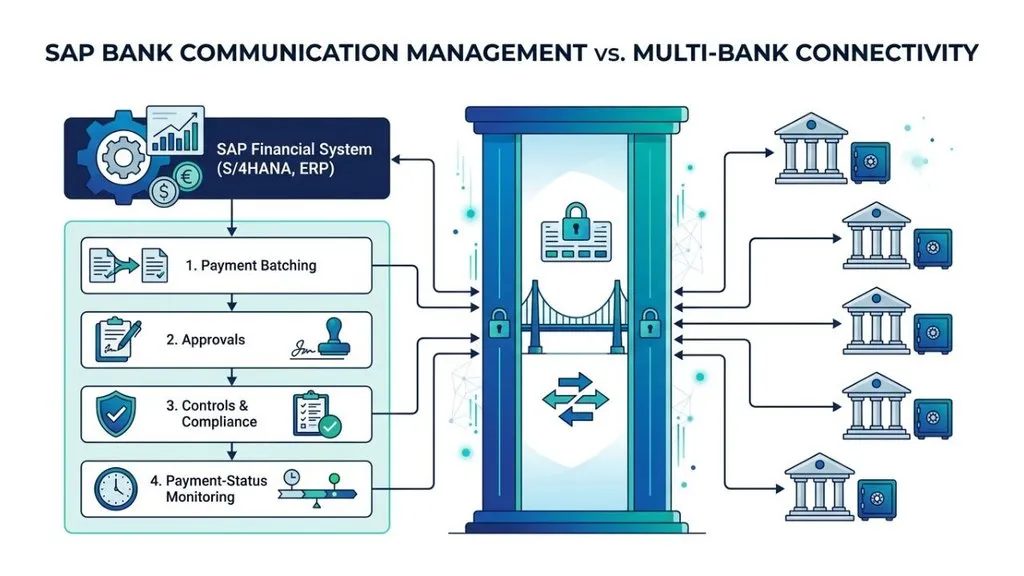
No. SAP Bank Communication Management and SAP Multi-Bank Connectivity serve different roles, although they can work together.
BCM primarily provides payment control, approval, batching and monitoring functions. Multi-Bank Connectivity provides a connectivity layer through which SAP customers can exchange messages with multiple banks and financial institutions.
SAP describes Multi-Bank Connectivity as a SaaS-based connectivity solution that allows banks and corporate customers to exchange messages, with a single connector instance capable of communicating with multiple banks. A useful mental model is:
| Component | Main role |
| SAP payment processes | Create payment instructions |
| SAP BCM | Group, approve and monitor payments |
| SAP Multi-Bank Connectivity | Exchange messages with banks |
| Bank | Execute or reject payment instructions |
| Bank statements/status messages | Return information to SAP |
| Treasury/accounting | Investigate exceptions and reconcile |
The two technologies therefore should not be treated as interchangeable.
How Does Bank Communication Management Improve Payment Security?
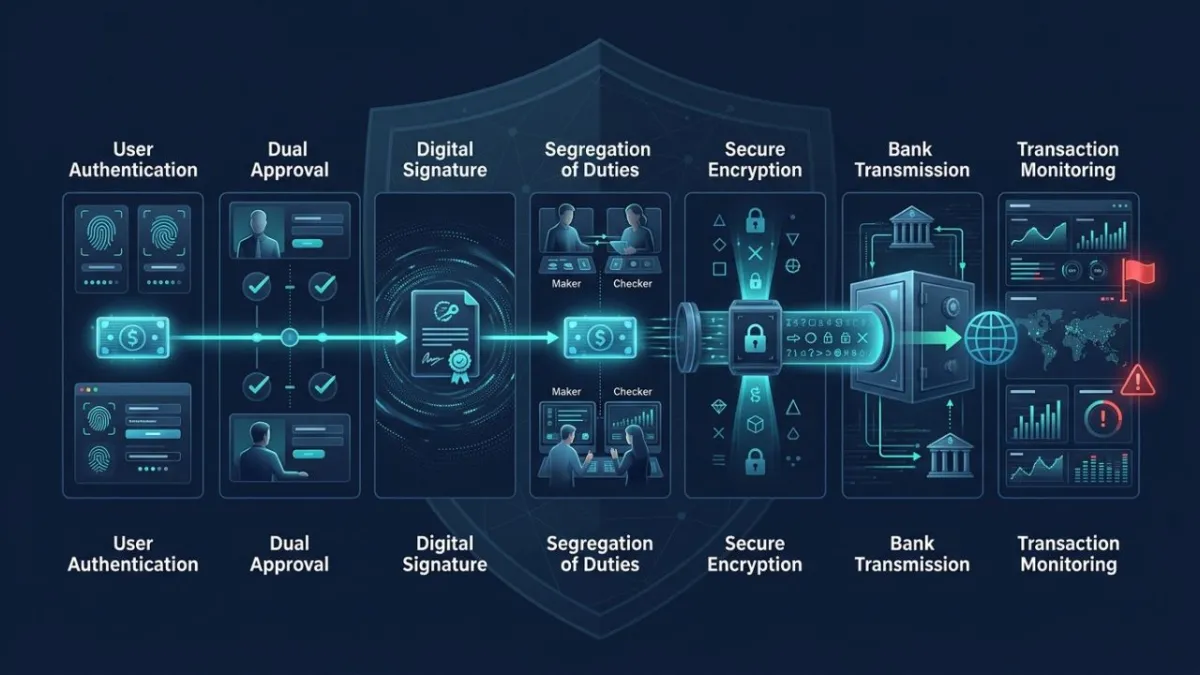
BCM can strengthen payment controls, but it cannot by itself eliminate payment fraud. Its security value comes from workflow controls, authorization separation, auditability, message protection and better visibility.
For example, SAP supports digital signatures and approval workflows, while the Multi-Bank Connectivity connector can be configured to sign and encrypt outbound messages and decrypt and verify inbound messages.
That matters because payment fraud frequently exploits processes rather than software bugs. The FBI’s Internet Crime Complaint Center warns that business email compromise can involve compromised accounts and fraudulent requests to transfer funds. It recommends independent verification of changes to payment information and other secondary controls.
In practice, companies should therefore combine SAP controls with operational safeguards such as:
- Segregation of duties
- Independent verification of beneficiary changes
- Strong identity and access management
- Approval limits
- Dual authorization for sensitive payments
- Bank-account master-data controls
- Exception alerts
- Regular access reviews
- Incident-response procedures
BCM is a control layer, not a guarantee against fraud.
What Is the Role of ISO 20022 in Bank Communication Management?
ISO 20022 matters because richer, structured payment data can improve automation, interoperability and payment monitoring. It is increasingly important to the architecture of modern bank communication.
The U.S. payments infrastructure has already moved significantly in this direction. The Federal Reserve completed the ISO 20022 migration for the Fedwire Funds Service in July 2025. The Federal Reserve says the richer data can support more efficient processing, fraud and risk mitigation, sanctions and anti-money-laundering compliance, and greater straight-through processing.
SAP’s current documentation shows BCM and Multi-Bank Connectivity working with ISO 20022 message types such as PAIN and CAMT. For example, PAIN.002 status messages can be handed to BCM for payment-batch status updates, while CAMT messages can be used for bank-statement processing. This is one reason companies should not view a BCM implementation as merely an old-fashioned payment-file project. Message standards, bank connectivity and structured payment data are continuing to evolve.
There is also a near-term international consideration: Swift says that after 14 November 2026, unstructured addresses will no longer be accepted for relevant ISO 20022 cross-border payment messaging, with fully structured or hybrid postal addresses required.
For companies operating internationally, payment master data therefore deserves as much attention as the technical interface.
What Does a Real SAP BCM Payment Process Look Like?
Consider a hypothetical U.S. manufacturer with 12 bank accounts and several hundred supplier payments each week.
The accounts-payable team creates a payment run totaling $2 million. Instead of immediately transmitting the entire file, the BCM process groups the payments according to configured rules.
Suppose:
- $1.4 million consists of ordinary domestic supplier payments.
- $400,000 consists of international payments.
- $200,000 consists of higher-risk or higher-value payments requiring additional approval.
The organization might configure different release requirements for those groups.
A $200,000 payment could require two authorized approvers. After the approvals are completed, the payment medium can be generated according to the configured process. The resulting messages can then be transmitted through the company’s banking connectivity architecture.
If the bank later rejects one transaction, the status message can flow back into SAP. Rather than discovering the rejection days later during manual reconciliation, the finance team can investigate the exception as part of the monitored process.
This example is hypothetical. Actual grouping, approval and transmission behavior depends on SAP release, configuration, banking relationships and the organization’s control framework.
What Are the Benefits of Bank Communication Management?
The strongest benefits are operational and control-related rather than simply cosmetic.
Better segregation of duties
Payment preparation and payment approval can be separated. This reduces reliance on a single employee controlling the complete payment process.
Greater visibility
Payment status information can be monitored centrally rather than checked separately across multiple bank portals.
Fewer manual handoffs
Automated communication and message processing can reduce repetitive file handling and manual data entry.
Better auditability
Approval decisions and digital-signature processes can provide evidence of who approved payment activity and when. SAP specifically identifies audit trails for payment approval decisions as a BCM capability.
Improved exception management
Alerts for missing acknowledgements, timeouts and rejected payments can help teams focus on transactions that need investigation.
Scalability
A centralized process can be more manageable than maintaining separate procedures for every bank, business unit and payment type.
What Are the Limitations and Risks?
BCM should not be sold as a magic solution. A poorly designed implementation can simply automate a weak process.
The major risks include:
- Configuration risk: Incorrect grouping or approval rules can delay legitimate payments or allow inappropriate transactions through.
- Master-data risk: Incorrect beneficiary or bank-account information can cause failed or misdirected payments.
- Connectivity risk: A technical connection can fail even when the ERP payment process itself is functioning.
- Bank-specific requirements: Banks may support different message formats, services and connectivity arrangements.
- Access risk: Excessive user privileges can undermine otherwise strong workflow controls.
- Operational risk: Employees may approve transactions without properly reviewing them.
- Integration risk: BCM depends on surrounding SAP financial processes and, in many architectures, external connectivity components.
- Change-management risk: ISO 20022 and banking-interface changes require ongoing testing and maintenance.
The most important lesson is that automation does not automatically equal control. A company can automate a bad approval policy just as efficiently as a good one.
How Should a Company Evaluate an SAP BCM Implementation?
A practical implementation assessment should begin with the business process rather than the software configuration.
1. Map the current payment lifecycle
Document who creates payments, who reviews them, who approves them, how files reach banks and how bank responses return.
2. Identify control points
Determine where the company needs:
- Dual approval
- Approval limits
- Segregation of duties
- Beneficiary verification
- Exception alerts
- Audit evidence
3. Inventory banking relationships
List each bank, account, payment method, country, currency, message format and connectivity channel.
4. Define payment-grouping rules
Do not create complex rules merely because the software allows them. Each rule should correspond to a genuine business or control requirement.
5. Test both success and failure
A serious test plan should include rejected payments, missing acknowledgements, duplicate files, incorrect data, unavailable bank connections and approval rejection.
6. Test the full lifecycle
Do not stop testing once the payment file is generated. Test:
ERP → BCM → connectivity → bank → status message → SAP → reconciliation.
SAP’s documentation provides specific integration and inbound-processing mechanisms for payment and bank messages, which makes end-to-end testing especially important.
7. Review the architecture after go-live
Bank connectivity, payment standards and security requirements change. An implementation that works today may require updates as banks introduce new message requirements or standards.
Bank Communication Management vs. Manual Bank Portals
For a small business with one bank and a handful of monthly payments, a sophisticated SAP BCM architecture may be unnecessary.
For a large organization, however, manually logging into numerous bank portals can create operational friction and control challenges.
| Area | Manual bank portals | Centralized SAP BCM approach |
| Payment approval | Often bank-specific | Centralized workflow can be configured |
| Payment visibility | Spread across portals | Central monitoring |
| Audit trail | Depends on bank/system | SAP approval records can support audit |
| Multiple banks | Repeated processes | Connectivity can be centralized |
| Status monitoring | Portal-by-portal | SAP monitoring capabilities |
| Automation | Limited by workflow | Greater potential for straight-through processing |
| Implementation effort | Lower initially | Higher initially |
| Best fit | Smaller/simple operations | Complex or high-volume environments |
The right choice depends on transaction volume, number of banks, internal controls, regulatory requirements and the existing ERP landscape.

What Should Treasury Teams Watch in 2026?
The payment environment is moving toward richer data, stronger automation and more structured messaging.
The Fedwire Funds Service’s ISO 20022 migration is already complete, while the Federal Reserve’s implementation center identifies another Fedwire release scheduled for November 16, 2026. Swift is also preparing the industry for the November 2026 ISO 20022 milestone concerning structured and hybrid addresses. For treasury teams, this means bank communication management should be treated as an evolving operating model rather than a one-time IT implementation.
The strategic question is no longer simply, “Can SAP send our payment file?”
A better question is:
Can our payment architecture reliably control, authenticate, transmit, monitor and reconcile payments across every bank and every relevant message type?
That question exposes weaknesses that a basic interface review may miss.
Frequently Asked Questions
Is SAP Bank Communication Management part of SAP S/4HANA?
Yes. SAP documentation identifies Bank Communication Management as an S/4HANA financial business function, with capabilities for monitoring and releasing payment media and controlling payment-related bank processes. Availability and licensing details depend on the specific SAP product and deployment model. BCM documentation also distinguishes between the product capabilities and optional connectivity components such as the SAP Integration Package for SWIFT.
Does SAP BCM support multiple banks?
Yes. SAP BCM can be used in a multi-bank environment, while SAP Multi-Bank Connectivity provides a connectivity mechanism for exchanging messages with multiple banks. SAP states that one MBC connector instance can be configured to communicate with multiple banks.The precise architecture depends on bank capabilities, connectivity requirements and the customer’s SAP landscape.
Does SAP BCM prevent payment fraud?
No. SAP BCM can strengthen payment controls, but it cannot guarantee that fraudulent payments will never occur. Approval workflows, digital signatures, segregation of duties and monitoring can reduce certain risks, but organizations still need independent verification, access controls and sound operational procedures.
This distinction is especially important because business email compromise and social engineering can manipulate legitimate employees into initiating or approving fraudulent transfers
Can SAP BCM handle bank statements?
Yes. Bank-statement monitoring is one of SAP BCM’s documented capabilities, and SAP’s Multi-Bank Connectivity connector can automatically process supported bank-statement message types. Supported scenarios include several CAMT formats as well as legacy statement formats. This can help connect payment execution with reconciliation and cash visibility.
What is the difference between SAP BCM and SAP Multi-Bank Connectivity?
BCM primarily manages payment control, batching, approval and status monitoring, while Multi-Bank Connectivity provides the communication infrastructure for exchanging messages with banks. They can be integrated so that approved payment messages travel through MBC and bank responses return to SAP.
Conclusion
Bank communication management helps businesses make payments more controlled, visible, and efficient. With SAP BCM, companies can manage payment approvals, batching, bank connectivity, status monitoring, and reconciliation within a more structured process. As banking standards such as ISO 20022 continue to evolve, a well-designed SAP BCM setup can help finance and treasury teams reduce manual work while strengthening payment controls and visibility.
Pingback: What Will Fail a Conventional Loan Appraisal? Key Issues