Introduction
A conventional loan appraisal can create problems for a home purchase for two main reasons: the property may not support the agreed purchase price, or the appraiser may identify serious condition issues affecting safety, soundness, or structural integrity. Minor cosmetic defects usually do not automatically stop conventional financing.
It helps to understand the difference. A dated kitchen is nothing like a failing roof, and a low valuation is not an electrical problem. Many properties listed on the market with minor deferred maintenance issues are eligible to be appraised “as is” and will not need repairs. However, serious issues may require repairs or additional evaluations.
What Will Fail a Conventional Loan Appraisal?
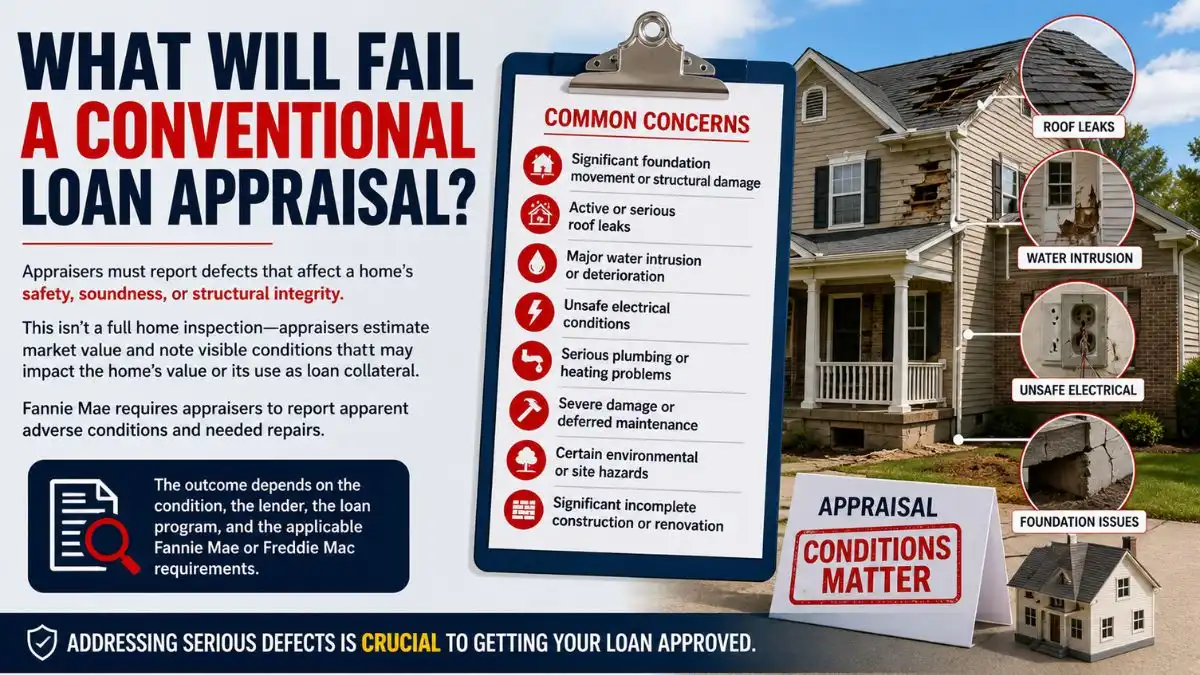
The most serious problems are defects that affect the home’s safety, soundness, or structural integrity. Examples can include major foundation problems, significant water intrusion, serious roof deficiencies, hazardous electrical conditions, or other defects that make the property unsafe or structurally compromised.
A standard appraisal is not performed the same way as a full home inspection. The appraiser’s work is to estimate market value and document any visible conditions that might impact the home’s market value or its use as loan collateral.
Fannie Mae requires appraisers to report apparent adverse conditions, needed repairs and deficiencies that affect safety, soundness or structural integrity.
Common concerns can include:
- Significant foundation movement or structural damage
- Active or serious roof leaks
- Major water intrusion or deterioration
- Unsafe electrical conditions
- Serious plumbing or heating problems
- Severe damage or deferred maintenance
- Certain environmental or site hazards
- Significant incomplete construction or renovation
The exact outcome depends on the condition, the lender, the loan program and the applicable Fannie Mae or Freddie Mac requirements. Learn how businesses manage bank communications with our guide to Bank Communication Management.
Does a Conventional Loan Require an Inspection?
A conventional mortgage generally requires an appraisal when the lender requires one, but a separate buyer-ordered home inspection is different. A general inspection is primarily designed to help the buyer understand the home’s physical condition and is not the same as an appraisal.
The distinction is important. An appraiser is not performing a detailed inspection of every component of the house. Fannie Mae says appraisers are not responsible for hidden or unapparent conditions.
A lender can, however, require additional professional evaluation when an appraisal reveals a potential problem. For example, a foundation concern could result in a structural inspection, while a suspected septic or roof issue could require an appropriate specialist’s report.
A buyer can therefore have two different layers of protection: an appraisal for the lender’s collateral decision and an independent inspection for a much broader assessment of the home’s condition.
What Are Conventional Loan Home Condition Requirements?
Conventional loan home condition requirements focus heavily on whether the property is suitable collateral and whether serious physical deficiencies have been addressed.
Fannie Mae uses standardized condition ratings from C1 through C6. These ratings describe a property’s overall condition rather than serving as a simple checklist of individual defects.
In plain English:
- C1: Essentially new construction.
- C2: Nearly new or recently comprehensively renovated, with little or no deferred maintenance.
- C3: Well-maintained property with limited normal wear.
- C4: Adequately maintained property with minor deferred maintenance and minimal repairs.
- C5: Significant repairs or updating are needed, although the property remains usable.
- C6: Severe deficiencies affect safety, soundness or structural integrity.
C4 is therefore not a failure. Fannie Mae permits C1 through C5 properties to be eligible “as is” when the applicable conditions meet its requirements. A property initially rated C6 requires correction of the deficiencies, with a minimum resulting condition rating of C5 for Fannie Mae eligibility.
What Do Appraisers Look for in a Conventional Loan?
Appraisers look at both the property’s market value and its observable physical condition. They consider factors such as location, size, layout, quality, condition, improvements and comparable sales.
The condition review is broader than simply asking whether the house looks attractive. The appraiser is concerned with factors that could affect the property’s usefulness, marketability, safety or value.
For example, worn carpet may be ordinary deferred maintenance. A roof with substantial deterioration or an active leak is potentially much more significant.
Fannie Mae requires the appraisal to reflect adverse conditions discovered during the appraisal process, including needed repairs and deterioration.
This is why buyers should not assume that a conventional appraisal ignores conditions. It is generally more flexible than FHA property standards, but serious defects can still affect financing.
How Strict Is a Conventional Loan Appraisal?
A conventional appraisal is generally more flexible about cosmetic wear than an FHA appraisal, but it is not a free pass for serious property problems. Safety, structural integrity and soundness remain important.
For example, outdated cabinets, older finishes or ordinary wear may not prevent financing. By contrast, major structural deterioration or a condition that makes the property unsafe can require repairs or professional evaluation.
Freddie Mac likewise uses C1–C6 condition ratings and requires appraisers to report the property’s condition and identify matters involving repairs or inspections.
The lender ultimately reviews the appraisal and determines what conditions must be satisfied before closing. That means two homes with similar visible issues can sometimes receive different underwriting treatment depending on the circumstances. Want to understand another debt-management strategy? Read our guide to Velocity Banking Explained.
FHA Appraisal vs Conventional Appraisal
An FHA appraisal and a conventional appraisal both consider value, but FHA financing has more prescriptive property-condition requirements.
FHA appraisals are tied to HUD’s Minimum Property Requirements, while conventional financing relies on the applicable Fannie Mae or Freddie Mac requirements and lender underwriting. This can make conventional financing more flexible when a property has ordinary cosmetic wear or minor deferred maintenance.
That does not mean FHA is always harder or conventional is always better. The right loan depends on the buyer’s finances, the property, and the circumstances.
For example, a home with dated flooring may be acceptable for conventional financing, while a serious safety issue could create problems under either loan type.
What Happens if the Appraisal Is Lower Than the Offer?
If the appraisal is lower than the purchase price, the lender may base the mortgage on the lower appraised value rather than simply accepting the contract price. The result can be an appraisal gap, meaning the buyer and seller must decide how to address the difference.
Imagine a buyer agrees to pay $400,000, but the appraisal comes in at $380,000. Depending on the loan terms and contract, possible solutions could include:
- The seller reduced the purchase price.
- The buyer contributes additional cash.
- The buyer and seller are negotiating a compromise.
- The parties challenge the appraisal if there is credible supporting information.
- The buyer exercising contractual rights if an appraisal contingency applies.
This is different from failing because of property conditions. A home can be structurally sound but appraise below the contract price because the comparable sales do not support the agreed value.
How Often Do Appraisals Come in Low?
There is no universal percentage that applies to every market, property type or year. Low appraisals depend on local market conditions, the availability of comparable sales, property uniqueness, rapidly changing prices and the relationship between the contract price and market evidence.
A low appraisal does not necessarily indicate that the appraiser made a mistake. The appraiser must develop an independent opinion of market value using appropriate data.
If you believe important information was overlooked, the lender may have a process for requesting a reconsideration of value. Fannie Mae’s appraisal review requirements require lenders to analyze the appraisal and related property information.
What Will Disqualify a Home From a Conventional Loan?
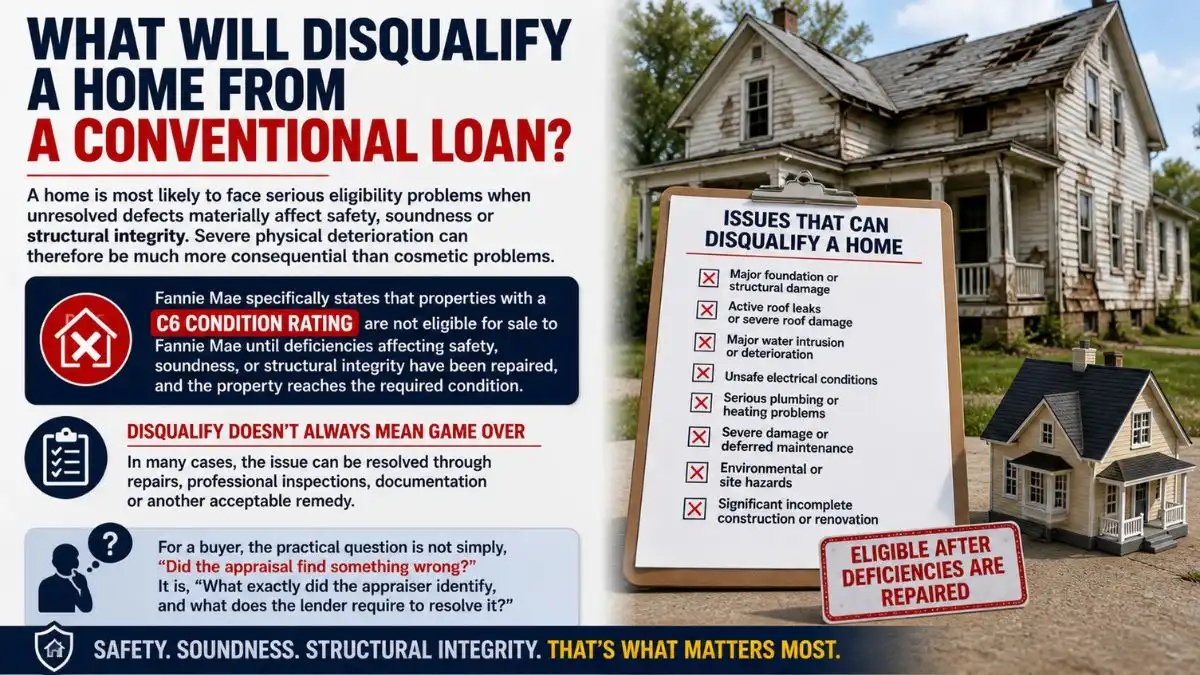
A home is most likely to face serious eligibility problems when unresolved defects materially affect safety, soundness or structural integrity. Severe physical deterioration can therefore be much more consequential than cosmetic problems.
Fannie Mae specifically states that properties with a C6 condition rating are not eligible for sale to Fannie Mae until deficiencies affecting safety, soundness, or structural integrity have been repaired, and the property reaches the required condition.
However, “disqualify” does not always mean the transaction is permanently dead. In many cases, the issue can be resolved through repairs, professional inspections, documentation or another acceptable remedy.
For a buyer, the practical question is not simply, “Did the appraisal find something wrong?” It is, “What exactly did the appraiser identify, and what does the lender require to resolve it?”
How Buyers Can Reduce Appraisal Problems
There’s nothing you can do to make the appraiser make the decision but there’s a lot you can do to prepare. Look for any obvious problems like leaks, stairs that are damaged, exposed wiring, water damage, or structural damage; you might want to hire a professional home inspector. Document major improvements, e.g. a new roof or a renovation. Although minor wear is not necessarily a big deal, serious issues in regard to safety, structure and property condition may call for repairs and have a negative impact on closing.
FAQ’s
Can a house with cosmetic problems get a conventional loan?
Yes. Minor cosmetic issues and ordinary wear generally do not automatically prevent conventional financing. The concern increases when a defect affects safety, soundness, structural integrity, or the property’s eligibility.
Does an old house automatically fail a conventional appraisal?
No. Age alone does not automatically disqualify a property. The home’s current condition, maintenance, functionality, marketability, and any significant physical deficiencies matter more.
Can a conventional appraisal require repairs?
Yes. If the appraiser identifies deficiencies affecting safety, soundness or structural integrity, the lender may require repairs, additional inspections or other documentation before the loan can proceed.
Can buyers challenge a low appraisal?
Potentially. A buyer can appeal the appraisal to their lender and may have the right to request a review if there is evidence that information was missed or that data from similar homes was omitted.
Conclusion
A conventional loan appraisal is designed to help determine whether a home provides suitable collateral for the mortgage. Serious issues involving safety, structural integrity, soundness, or significant property defects can create appraisal problems, while ordinary cosmetic wear usually does not. A low appraisal can also affect financing if the home’s market value does not support the agreed purchase price. Buyers can reduce surprises by arranging a professional inspection, reviewing obvious property issues, and keeping records of major improvements. Understanding the difference between appraisal value and property condition makes the process easier to navigate and helps buyers respond more confidently when concerns arise.