The Netherlands has quietly moved about 86 tonnes of gold from the United States and Canada to London, in a move that highlights how central banks are reassessing the location of their reserves as geopolitical tensions rise.
The transfer was carried out between March and August 2026 by De Nederlandsche Bank (DNB), the Dutch central bank. DNB said the decision was made to improve the accessibility and tradability of its gold reserves and strengthen its preparedness for a potential crisis.
The move does not mean the Netherlands has sold its gold. Instead, it has changed where part of its gold reserves are held.
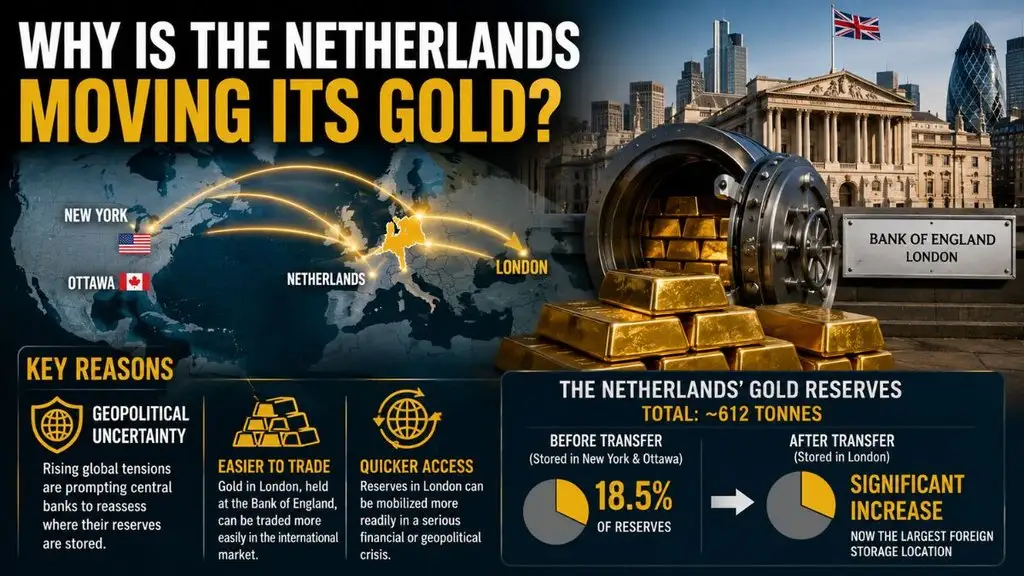
Why Is the Netherlands Moving Its Gold?
DNB said growing geopolitical uncertainty was one of the reasons behind the decision.
Gold held in London, particularly at the Bank of England, can be traded more easily in the international market. According to DNB, this could make the reserves more readily available if they are needed during a serious financial or geopolitical crisis.
That practical consideration appears to have played a major role in the decision.
The Netherlands has around 612 tonnes of gold reserves. Before the latest operation, a substantial portion was stored in New York and Ottawa. After the transfer, the share held in each of those locations fell to about 18.5%, while London’s share increased significantly.
London has now become the largest foreign storage location for Dutch gold. Gold remains a key focus as geopolitical risks rise. Read our latest Dell stock analysis for more market insights.
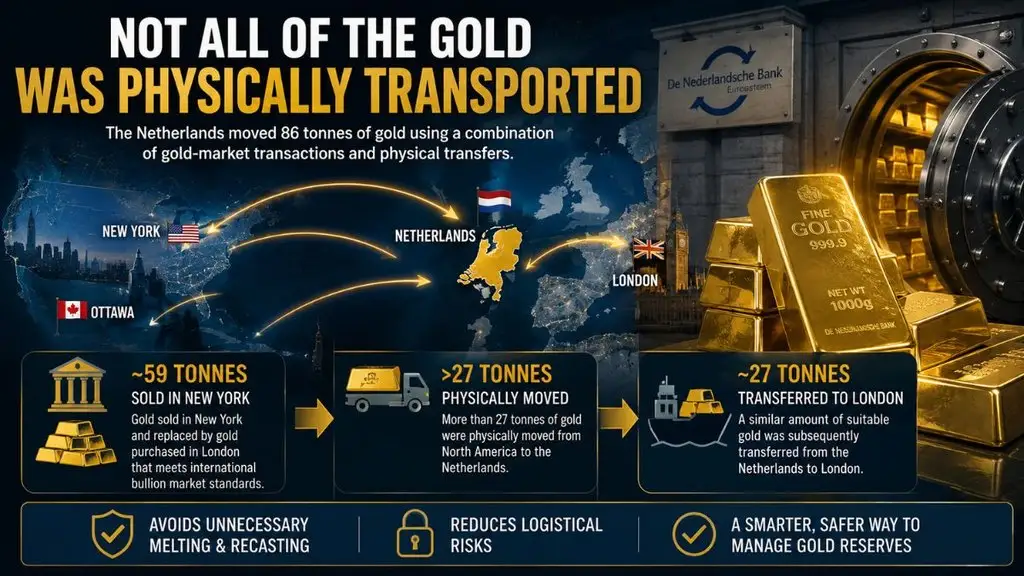
Not All of the Gold Was Physically Transported
The headline figure of 86 tonnes can make the move sound like thousands of gold bars were simply loaded up and shipped across the Atlantic.
The reality was more complicated.
DNB used a combination of gold-market transactions and physical transfers.
DNB sold about 59 tonnes of gold in New York. It then bought an equivalent amount in London that met international bullion standards.
The bank also moved more than 27 tonnes of gold from North America to the Netherlands. It later transferred a similar amount from the Netherlands to London.
This approach allowed the central bank to avoid unnecessarily melting and recasting large quantities of gold while also reducing the logistical risks involved in moving such valuable material.
Why London?
London is one of the world’s most important centres for physical gold trading. The city’s bullion market handles large transactions between banks, central banks and other financial institutions.
For DNB, that makes London an attractive location for reserves that may need to be accessed quickly.
The central bank has stressed that gold stored in London can be deployed more easily in a crisis than some of its holdings in New York and Ottawa.
The decision is therefore less about where the Netherlands feels safest politically and more about where its gold can be traded and mobilised most efficiently.
Is This Gold Repatriation?
Not exactly.
The Netherlands previously carried out a more traditional gold repatriation in 2014, when it brought more than 120 tonnes of gold from New York back to the Netherlands.
The latest move is different. Rather than bringing the gold entirely home, DNB has redistributed its holdings between several locations.
That makes the move better described as gold reserve repositioning rather than outright repatriation.

A Bigger Question for Central Banks
The Dutch decision comes at a time when central banks are paying greater attention to where their physical reserves are stored.
Gold is unusual because it is not the liability of another government or financial institution. But where that gold is physically located can still affect how quickly it can be accessed, traded or moved during a crisis.
The Netherlands is not the only European country to reconsider the geographical distribution of its bullion reserves. France has also moved gold previously held in New York, while other European countries continue to debate the balance between keeping reserves at home and maintaining access to major international financial centres.
Still, DNB has not presented its decision as a rejection of the United States or a signal that it expects a specific crisis.
Its message is more measured: central banks need to be prepared for uncertainty before a crisis arrives.
What the Dutch Move Tells Us
The Netherlands still owns its gold. What has changed is where a significant portion of that gold is kept.
By moving 86 tonnes toward London, DNB has placed more of its reserves close to one of the world’s biggest gold-trading markets while reducing its dependence on storage in North America.
The move is a reminder that central-bank reserves are not just about how much gold a country owns. Where that gold sits can also become a strategic decision.
Geopolitical tensions are reshaping global finance. Other central banks may now review where they store their gold. Should they keep it in traditional locations or move it closer to key markets? The Wall Street Journal reported that the Netherlands moved its gold reserves from North America to London amid rising geopolitical concerns