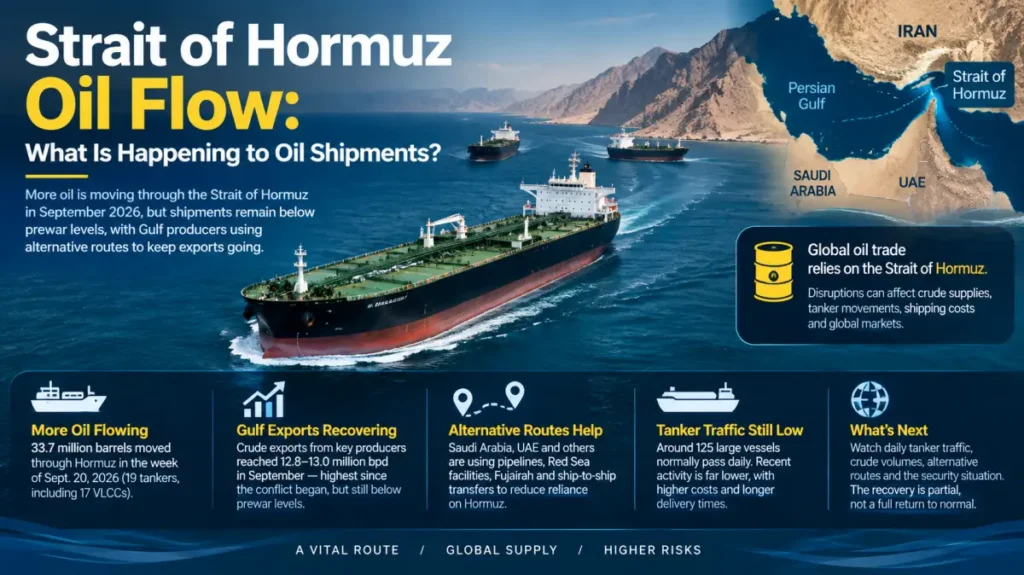
Oil flows through the Strait of Hormuz have increased in September 2026, but shipments remain well below normal prewar levels. Recent tracking data shows that Gulf producers are moving more crude through the strait while also relying on alternative routes to keep exports moving.
The change is important because the Strait of Hormuz is one of the world’s most important energy shipping routes. Disruptions there can affect crude supplies, tanker movements, shipping costs and global oil markets.
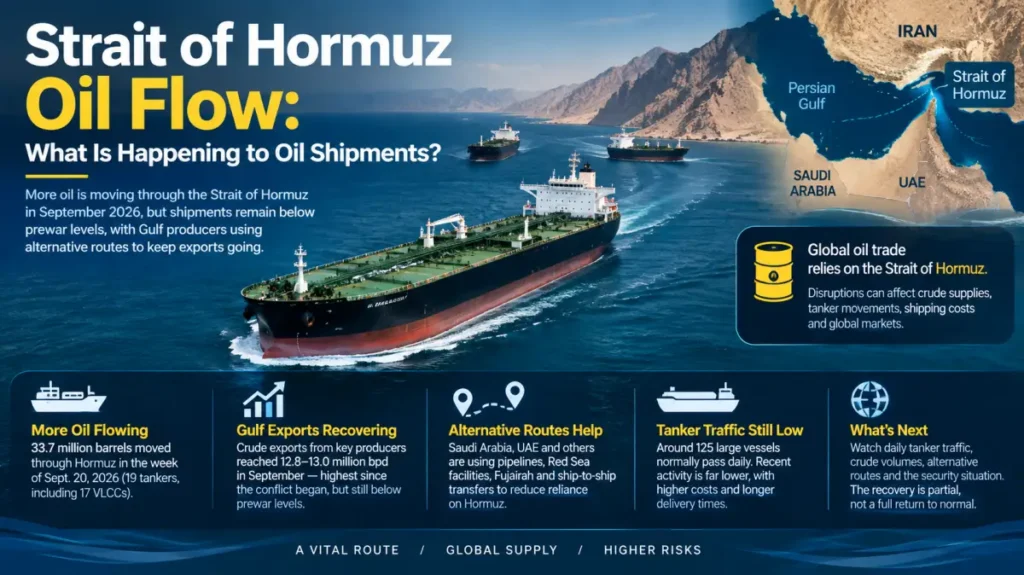
Strait of Hormuz Oil Flow Is Picking Up
Recent data shows a clear increase in crude movement through Hormuz compared with the lowest levels seen during the conflict.
According to Kpler data reported by Reuters, about 33.7 million barrels of crude moved through the Strait of Hormuz during the week beginning September 20. Nineteen tankers carried the oil, including 17 very large crude carriers (VLCCs). Most of the shipments came from Saudi Arabia and Iraq.
The weekly figure was below the previous week’s 49.2 million barrels, showing that the recovery has not been steady. Ship traffic has remained highly uneven from one day to another.
Reuters also reported that around 60 commercial vessels crossed the strait on one Wednesday, the highest daily crude-related traffic recorded since early July. But the following day, only nine commodity vessels were recorded, highlighting how quickly shipping activity can change.
Global markets are also closely watching developments in the technology sector, including the financial details emerging from Anthropic’s planned public offering. Anthropic IPO Prospectus examines the company’s revenue growth, infrastructure costs and risks outlined in its filing.
Gulf Oil Exports Are Moving Closer to Normal
The wider Gulf oil trade has also recovered.
Kpler data cited in recent reports indicates that crude exports from major Middle Eastern producers reached roughly 12.8 million to 13 million barrels per day in September. That is the highest monthly level since the conflict began, although it remains below the region’s prewar volume.
The Wall Street Journal reported that Middle Eastern crude exports through Hormuz and alternative routes were approaching 80% of prewar regional flows. This recovery has been supported by increased tanker movements and the use of routes that avoid the strait.
However, the numbers should not be interpreted as a complete return to normal. Shipping remains more complicated, expensive and vulnerable to disruption than before the conflict. The changing outlook for technology investment is also affecting AI-related markets, as investors reassess expectations for rapid AI infrastructure spending. AI trade faces pressure as development.
Alternative Routes Are Helping Keep Oil Moving
Oil producers have increasingly turned to alternatives when direct passage through Hormuz becomes difficult.
Saudi Arabia, for example, has used its pipeline network and Red Sea export infrastructure to reduce dependence on the strait. The United Arab Emirates has also relied on its Fujairah facilities, while producers and traders have increased ship-to-ship transfers in the Gulf of Oman.
Reuters reported that ship-to-ship transfers have become increasingly important but are also facing capacity limits. Saudi Arabia’s increased exports through Hormuz have created greater demand for VLCC tankers, contributing to congestion and higher shipping costs.
These alternatives do not completely replace the normal shipping system. Instead, they provide additional ways for producers to move crude when traditional routes are disrupted.
Why Tanker Traffic Matters
The number of ships passing through Hormuz is an important indicator of the health of the oil trade.
Before the current disruption, the waterway handled far more commercial traffic. Reuters reported that roughly 125 large commercial vessels normally passed through the strait each day, while recent activity has been dramatically lower. Some vessels may also go uncounted because they operate without active tracking signals.
For oil buyers, fewer available tankers can mean longer delivery times and higher freight costs. Reuters reported that some ship-to-ship transfers now take close to 10 days, compared with roughly five to seven days previously.
What the Recovery Means for Global Oil Markets
The recovery in Hormuz oil flows provides some relief to global energy markets because more Middle Eastern crude is reaching international buyers.
Still, the situation remains uncertain. Oil shipments can change quickly if security conditions deteriorate, while alternative routes have limited capacity and can cost more.
The recent increase in exports therefore suggests that the global oil trade has adapted to the disruption, rather than that the risks surrounding the Strait of Hormuz have disappeared.
What to Watch Next
The key indicators will be daily tanker traffic, crude volumes through Hormuz, alternative export routes and the security situation around the waterway.
For now, the picture is one of partial recovery rather than a full return to normal. More oil is moving through the Strait of Hormuz than during the worst period of disruption, but flows remain below prewar levels and the shipping network continues to operate under unusual pressure.
The Strait of Hormuz remains central to the global oil trade, making changes in its shipping activity important not only for Gulf producers but also for refiners, tanker companies and consumers around the world.