Artificial intelligence is becoming increasingly important in banking, lending, insurance, investment management, fraud detection, and other financial services. AI can process large amounts of information quickly and identify patterns that may be difficult for people to detect manually. But as financial institutions rely more heavily on AI, another question becomes important: Can people understand why an AI system made a particular decision?
The key advantage of explainable AI in finance is that it makes AI-driven decisions easier for people to understand, review, and question. This can support transparency, accountability, risk management, and human oversight.
However, explainable AI does not automatically make a financial model accurate, fair, or legally compliant. Those outcomes depend on many factors, including data quality, model design, testing, governance, applicable laws, and how the system is used.

What Is Explainable AI in Finance?
Explainable AI, commonly called XAI, refers to methods and techniques that help people understand how an artificial intelligence or machine-learning system reaches an output.
In finance, an AI system might be used to assess credit risk, identify potentially fraudulent transactions, evaluate financial risk, or support investment analysis. A traditional complex AI model may produce a result without making its reasoning easy for a human to understand.
This is often called the black-box problem.
For example, imagine a lending system that recommends rejecting a loan application. Simply displaying “application rejected” gives very little information about the decision. An explainable system may provide information about the factors that contributed to the result, such as income, existing debt, payment history, or other relevant data.
The purpose is not necessarily to expose every mathematical calculation inside the model. Instead, the goal is to provide useful information that allows appropriate people to understand and evaluate the decision.
The growing use of AI in financial services also makes it useful to understand the economics and risks behind leading AI companies. For a closer look, read our Anthropic IPO prospectus analysis.
What Is the Key Advantage of Explainable AI in Finance?
The key advantage is greater transparency and accountability in AI-assisted financial decision-making.
When people can understand the important factors behind an AI output, they are better positioned to review that output and identify potential problems.
For example, suppose an AI system identifies a transaction as potentially fraudulent. Without an explanation, an employee may see only a fraud alert. With an explanation, the system might identify unusual transaction behavior or other factors that contributed to the alert.
A human investigator can then review the information before deciding what action, if any, should be taken.
This creates an important distinction between automation and accountable automation. AI can make or support decisions quickly, but financial institutions may still need people to monitor the system, investigate unusual outcomes, and address errors or other concerns.
Why Does Explainability Matter in Financial Services?
Financial decisions can have significant consequences for individuals and businesses. A credit decision may affect someone’s ability to obtain a loan. A fraud alert may temporarily affect access to an account. An automated risk assessment may influence how a financial institution evaluates a customer or transaction.
Because of these consequences, understanding how automated systems operate can be valuable.
Explainability can help different groups for different reasons:
- Customers may want to understand decisions that affect them.
- Employees may need to investigate unusual AI-generated results.
- Risk teams may use explanations to monitor model behavior.
- Compliance teams may need information to evaluate applicable requirements.
- Auditors and reviewers may need evidence about how a system operates.
- Management may use explanations when overseeing AI-related risks.
The specific information required will depend on the financial application, the organization, the applicable legal framework, and the people using the system.
How Does Explainable AI Work?
There is no single method for making an AI system explainable. Different techniques are suitable for different models and situations.
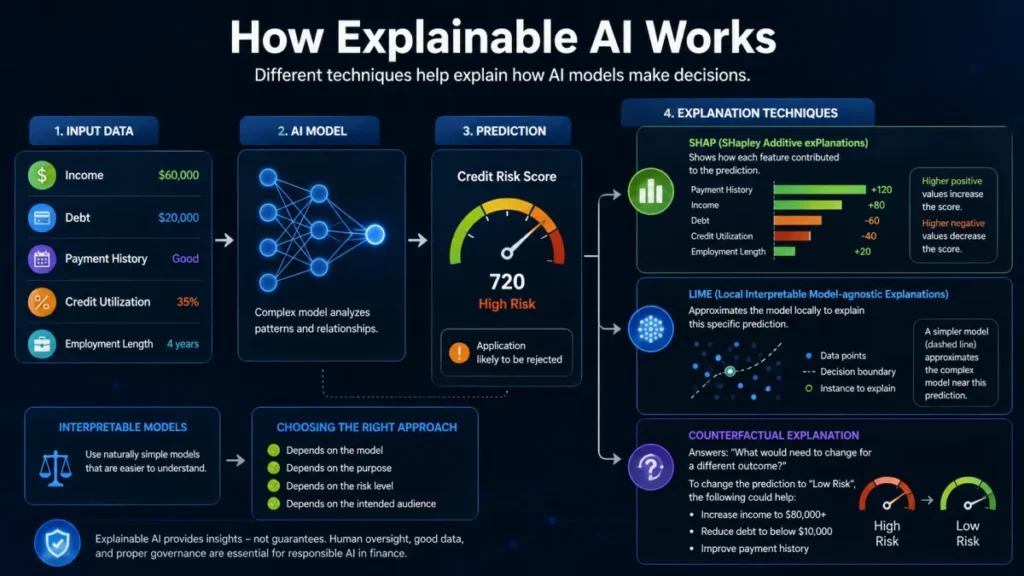
One commonly discussed approach is SHAP, which estimates how individual input variables contributed to a particular prediction. In a hypothetical credit-risk model, SHAP could help show whether factors such as income, debt, or payment history had a significant influence on an output.
Another approach is LIME, which can create a simpler approximation around a particular prediction to help explain that individual result.
There are also counterfactual explanations. These focus on questions such as: “What would need to change for the outcome to be different?”
For example, a hypothetical financial model might indicate that a particular combination of financial circumstances contributed to a negative result. A counterfactual explanation could help show which relevant inputs would have needed to change for the model to produce another outcome.
Some organizations may also choose models that are naturally easier to interpret, rather than relying on highly complex systems.
The appropriate approach depends on the model, purpose, risk level, and intended audience.
How Is Explainable AI Used in Finance?
Explainable AI can be applied to several areas of financial services.
Credit and Lending
Banks and other lenders may use automated systems to help assess credit applications and financial risk.
Explainability can help authorized reviewers understand which factors influenced a model’s output. This may make it easier to investigate unusual results or identify potential data and model problems.
However, an explanation should not be treated as proof that a lending decision is legally correct. Financial institutions must still follow applicable laws, regulations, policies, and established review procedures.
Fraud Detection
Financial institutions process large numbers of transactions, making automated fraud detection useful for identifying unusual activity.
An explainable fraud-detection system can provide information about why a particular transaction was flagged. This may help investigators determine whether further review is appropriate.
An alert is not necessarily proof of fraud. Human review and additional evidence may still be necessary.
Investment Analysis
AI can be used to analyze market information, financial data, and other inputs to support investment research or portfolio analysis.
Explainability can help professionals understand which factors influenced an AI-generated forecast or recommendation.
However, an understandable explanation does not make an investment prediction certain. Financial markets are uncertain, and AI-generated outputs can be wrong.
Insurance
AI may also be used in insurance-related risk assessment, claims processing, and other activities.
Explainability can help organizations understand the factors influencing automated outputs and provide additional information for appropriate review.
The legal requirements for these applications vary depending on the jurisdiction and specific use of the technology.
Can Explainable AI Reduce Bias?
Explainable AI can help identify potential bias, but it does not guarantee that an AI system is unbiased.
Suppose an AI model produces different outcomes for different groups. An explanation may help researchers and risk teams investigate which variables are influencing those outcomes.
This can be useful because a model may sometimes rely on patterns that are technically predictive but inappropriate for the purpose of the decision.
However, identifying a possible problem is only the beginning. Addressing bias may require changes to the data, model, decision process, monitoring system, or governance framework.
Fairness is also a legal and social issue, not simply a technical one. The relevant standards can differ according to the country, industry, product, and type of financial decision.
Therefore, explainability should be considered one part of responsible AI governance rather than a complete solution to algorithmic bias.
What Are the Legal and Regulatory Considerations?
The legal treatment of AI in finance varies by jurisdiction and continues to develop. Financial institutions should therefore avoid assuming that using an explainable AI system automatically satisfies every legal or regulatory requirement.
Depending on the situation, organizations may need to consider rules concerning consumer protection, discrimination, privacy, data protection, financial services, recordkeeping, model governance, and automated decision-making.
Explainability can support compliance activities by making certain decisions and model behavior easier to examine. But compliance generally requires more than simply producing an explanation.
Organizations may also need appropriate documentation, testing, monitoring, data controls, security measures, human oversight, and procedures for handling errors or complaints.
For this reason, financial institutions should assess AI systems according to the laws and regulations applicable to their particular operations rather than relying on a general assumption that “explainable AI equals compliant AI.”
What Are the Limitations of Explainable AI?
Explainability has important limitations.
First, an explanation may simplify a highly complex model. A simplified explanation can be useful, but it may not represent every aspect of the underlying system.
Second, some explanations are produced after the model has made its prediction. These are sometimes called post-hoc explanations. They can provide valuable insight, but users should understand what the explanation actually represents.
Third, explanations can sometimes create false confidence. A financial professional may see a clear explanation and assume that the underlying decision must therefore be correct. That conclusion does not necessarily follow.
Finally, there can be a balance between model complexity, predictive performance, and interpretability. A simpler model may be easier to understand, while a more complex model may identify patterns that simpler approaches do not capture.
There is no universal model that is best for every financial application.
What Should Beginners Know About Explainable AI?
The simplest way to understand explainable AI is to think about the difference between receiving an answer and understanding the important reasons behind that answer.
A traditional automated system might say:
“High-risk transaction.”
An explainable system could provide additional information about the factors that caused the transaction to be flagged.
That additional information gives a human reviewer something to examine.
For beginners, three questions are useful when evaluating an AI explanation:
- What information does the explanation actually provide?
- Who is the explanation designed for?
- Can a qualified person use it to review or challenge the result?
An explanation designed for a technical model developer may be very different from one designed for a customer.
Good explainability should therefore be appropriate to its audience and purpose.
Does Explainable AI Replace Human Judgment?
No. Explainable AI is generally intended to support human understanding rather than eliminate human judgment.
An AI model can process information quickly, but it does not necessarily understand circumstances in the same way a person does. Financial decisions can also involve information that is difficult to capture completely in a model.
Human oversight can be particularly important when an AI system produces an unexpected result, when the consequences of a decision are significant, or when additional context is needed.
The appropriate level of human involvement depends on the application and risk involved.
Final Thoughts
The key advantage of explainable AI in finance is its ability to make AI-assisted decisions more understandable and reviewable.
That can help financial institutions improve transparency, strengthen oversight, investigate unusual results, and better understand how automated systems behave.
At the same time, explainability should not be confused with accuracy, fairness, or legal compliance. An AI system can be explainable and still produce incorrect or inappropriate results.
For that reason, responsible use of AI in finance requires a broader approach that includes reliable data, appropriate model testing, ongoing monitoring, security, governance, legal review, and meaningful human oversight.
Explainable AI is most useful when it gives people enough information to understand what an AI system is doing—and enough visibility to question it when something does not appear right.