Introduction
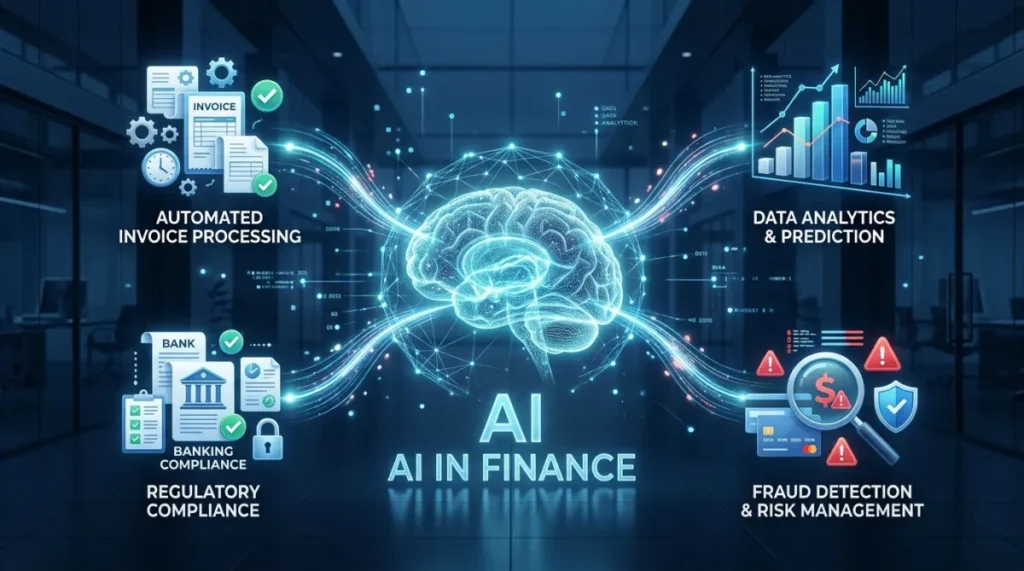
The use of artificial intelligence in accounting and finance is changing how businesses manage financial information and routine accounting work. AI can process large amounts of data, automate repetitive tasks, identify unusual transactions, assist with forecasting, and help finance professionals analyze information more efficiently.
However, AI is not simply about replacing accountants. Its bigger role is to reduce manual work and give finance professionals more time for analysis, decision-making, controls, and strategic advice.
This article explains how AI is used in accounting and finance, its main benefits and risks, how intelligent automation works, and whether AI could replace accountants in the future.
What Is the Use of Artificial Intelligence in Accounting and Finance?
The use of artificial intelligence in accounting and finance involves applying technologies such as machine learning, natural language processing, computer vision, generative AI, and intelligent automation to financial processes.
AI can assist with:
- Processing invoices and receipts
- Categorizing financial transactions
- Bank and account reconciliation
- Fraud and anomaly detection
- Financial forecasting
- Data analysis
- Financial reporting
- Document review
- Audit support
- Cash-flow analysis
For example, instead of an employee manually reviewing thousands of transactions, an AI system can analyze the transactions and identify unusual items that deserve human attention.
Research into AI applications in accounting and finance has identified potential improvements in efficiency, data processing and financial analysis, while also highlighting challenges such as data quality, privacy and human oversight. For a deeper look at transparency and human oversight in financial AI, read our guide on the key advantage of explainable AI in finance.
How Is AI Used in Finance and Accounting?
Direct Answer: AI is used in finance and accounting to automate repetitive processes, analyze financial data, detect unusual activity, support forecasting, and provide decision-making assistance.
Invoice Processing
AI-powered systems can read invoices and extract information such as supplier names, dates, invoice numbers, amounts and tax information.
The extracted data can then be transferred into an accounting system for review and approval. This can reduce manual data entry and allow employees to focus on exceptions.
Transaction Categorization
AI can analyze historical transactions and suggest categories or accounting codes based on previous patterns.
An accountant can review these suggestions before transactions are finalized, particularly when an item is unusual or financially significant.
Reconciliation
AI can compare transactions from bank accounts with records in accounting systems and identify likely matches.
Instead of checking every transaction manually, accountants can concentrate on unmatched or unusual items.
Fraud Detection
AI can examine large volumes of financial activity and identify patterns that differ from normal behavior.
It may flag duplicate invoices, unusual payment amounts, unexpected supplier activity or other anomalies. A warning does not automatically mean fraud; it simply identifies something that may require investigation.
Forecasting
AI can analyze historical financial information and current data to support forecasts for revenue, expenses and cash flow.
These forecasts are estimates rather than guarantees. Their usefulness depends on the quality of the data and the assumptions behind the model.
Why Does AI Matter in Accounting and Finance?
AI matters because many accounting activities involve large amounts of structured data and repetitive processes.
When technology handles appropriate routine tasks, finance professionals can spend more time on activities that require judgment and communication.
The potential benefits include:
| Area | How AI Can Help |
|---|---|
| Efficiency | Automates repetitive financial tasks |
| Data analysis | Processes large datasets quickly |
| Monitoring | Identifies unusual transactions |
| Reporting | Assists with summaries and analysis |
| Forecasting | Supports financial projections |
| Productivity | Reduces manual administrative work |
The goal should not simply be to automate as much as possible. A better objective is to determine which tasks can be automated safely while keeping appropriate human oversight.
Professional accounting organizations, including ACCA and IFAC, have emphasized the changing role of technology and the need for finance professionals to develop digital and analytical skills.
Key AI Technologies Used in Accounting
AI in accounting includes several different technologies rather than one single tool.
Machine Learning
Machine learning allows software to identify patterns in historical data and use those patterns for classification, prediction or anomaly detection.
It can support transaction categorization, fraud monitoring and forecasting.
Natural Language Processing
Natural language processing helps computers understand and work with human language.
In finance, it can be used to analyze documents, summarize information and allow users to ask questions about financial data using ordinary language.
Computer Vision
Computer vision allows software to extract information from images and scanned documents.
A simple example is automatically reading information from a scanned receipt.
Generative AI
Generative AI can produce text, summaries, explanations and other content based on user instructions.
Finance professionals may use it to summarize documents, prepare initial report drafts or explore financial information. Important outputs should always be checked because generative AI can produce convincing but incorrect information.
Intelligent Automation
Intelligent automation combines traditional automation with AI and related technologies.
For example, an intelligent system could receive an invoice, extract its information, compare it with purchasing records, identify an exception and send the invoice to the appropriate employee for approval.

Benefits of AI in Accounting and Finance
The benefits of AI depend on how it is implemented and the quality of the underlying data.
Reduced Manual Work
AI can automate repetitive activities such as data entry, transaction matching and document processing.
This can give accounting employees more time for analysis and problem-solving.
Faster Financial Analysis
AI can process large datasets much faster than a manual review.
Finance teams can use this capability to identify trends, compare information and investigate unusual results.
Improved Monitoring
AI systems can continuously analyze transactions and identify patterns that may otherwise be difficult to notice.
This can strengthen monitoring, although human investigation remains important.
Better Use of Employee Time
When routine work is automated, accountants can potentially spend more time on forecasting, financial planning, internal controls, business analysis and communication.
This is one reason technology is changing the role of accountants rather than simply eliminating it.
Risks and Limitations of AI in Finance
AI can be useful, but it also introduces important risks.
Inaccurate Results
AI systems can produce incorrect classifications, predictions or answers. Generative AI can also produce false information that sounds credible.
Poor Data Quality
An AI system cannot reliably solve problems caused by incomplete, inconsistent or inaccurate financial data.
Privacy and Security
Financial records can contain sensitive information about customers, employees and businesses. Organizations must carefully consider how AI systems store, process and protect that information.
Bias
AI systems can reproduce problems contained in historical data or created by model design.
Lack of Explainability
Some AI systems make it difficult to understand precisely why a particular output was produced. This can create problems when important financial decisions depend on the result.
Overreliance on Technology
Employees may accept AI recommendations without properly reviewing them. For important accounting and financial decisions, human judgment and appropriate controls remain essential.
NIST’s AI Risk Management Framework highlights areas including reliability, security, transparency, privacy and accountability when organizations manage AI risks.
Can AI Replace Accountants or ACCA?
Direct Answer: AI can automate some accounting tasks, but it is unlikely to replace the need for professional accountants or qualifications such as ACCA. Accounting involves judgment, ethics, communication, interpretation and responsibility that cannot simply be reduced to automated data processing.
AI may increasingly handle activities such as:
- Data entry
- Transaction matching
- Document processing
- Basic analysis
- Reconciliation
- Report drafting
Accountants, however, still need to evaluate results, investigate exceptions, communicate with clients and management, apply professional judgment and take responsibility for important decisions.
ACCA is also adapting to technological change. Its future qualification framework places greater emphasis on areas such as technology, data and AI, reflecting the changing skills expected from future accountants.
For accounting students and professionals, learning how to use AI responsibly may therefore become an important career skill.
What Is IA in Accounting?
Direct Answer: IA in accounting generally means Intelligent Automation. It combines automation with technologies such as artificial intelligence and machine learning to complete connected accounting processes with less manual intervention.
For example, an intelligent accounts-payable workflow could:
- Receive an electronic invoice.
- Extract the relevant information.
- Compare it with purchase-order records.
- Identify differences.
- Send the invoice for approval.
- Record the approved transaction.
- Reconcile the payment.
- Escalate unusual items to an accountant.
The difference between simple automation and intelligent automation is that IA can use data and AI-based analysis to handle more complex situations rather than merely following a fixed sequence of instructions.
A Practical Example of AI in Accounting
Imagine a business receives 5,000 supplier invoices every month.
Under a traditional process, employees may manually enter invoice information, compare documents, check amounts and reconcile payments.
An AI-enabled system can extract invoice information automatically, compare it with purchase orders and identify invoices that do not match expected amounts.
Suppose an invoice is significantly higher than the corresponding purchase order. The system can flag it for review.
The accountant then investigates whether the additional amount is legitimate.
This approach illustrates the most practical role of AI: machines handle repetitive pattern-based work, while people focus on exceptions, judgment and accountability.
How Should Businesses Adopt AI in Accounting?
Businesses should start with a clear accounting problem rather than adopting AI simply because it is popular.
1. Choose a suitable process
Look for repetitive activities such as invoice processing, reconciliation or document classification.
2. Define success
Measure factors such as processing time, error rates, manual interventions and exception rates before introducing the technology.
3. Review data quality
Make sure the financial data being used is accurate, complete and properly structured.
4. Protect sensitive information
Review access permissions, security controls and the way an AI provider handles financial and personal data.
5. Keep human oversight
High-impact decisions involving financial reporting, payments, compliance or unusual transactions should have appropriate human review.
6. Monitor performance
AI systems should be tested regularly. Businesses should investigate errors and update controls when the system or underlying data changes.
Frequently Asked Questions
How is artificial intelligence being used in accounting?
Direct Answer: AI is being used for invoice processing, transaction classification, reconciliation, anomaly detection, forecasting, document analysis and financial reporting support.
It is particularly useful for repetitive and data-heavy processes.
Can AI replace accountants?
Direct Answer: AI can replace some accounting tasks, but it does not eliminate the need for accountants.
Professional judgment, ethics, communication, oversight and responsibility remain important parts of accounting.
Can AI replace ACCA?
Direct Answer: No. AI cannot replace the ACCA qualification. Instead, it is changing the skills accountants need, including digital literacy, data analysis and responsible use of technology.
Is AI accurate enough for accounting?
Direct Answer: AI can be useful for accounting, but its outputs should not automatically be considered correct.
Important financial information should be checked against reliable data, applicable accounting requirements and professional judgment.
What are the biggest risks of AI in finance?
Direct Answer: Major risks include inaccurate results, poor data quality, privacy problems, cybersecurity concerns, bias, limited explainability and excessive reliance on automated recommendations.
Strong governance and human oversight can reduce these risks.
Will AI create opportunities for accountants?
Direct Answer: Yes. AI can reduce routine processing and allow accountants to focus more on analysis, financial planning, controls, advisory services and strategic decision-making.
Conclusion
The use of artificial intelligence in accounting and finance is changing the way financial teams process information and perform routine work. AI can help with invoices, reconciliation, transaction analysis, fraud monitoring, forecasting and reporting.
But AI is not a substitute for professional judgment. The most effective approach combines automated technology with human oversight, reliable data and strong internal controls.
For accountants and finance professionals, the future is likely to involve less repetitive processing and more analysis, interpretation and technology management. Learning how to use AI effectively—and knowing when its output needs to be challenged—can become an important professional advantage.