If you make $25 an hour and work 40 hours per week, your gross weekly pay is $1,000. After estimated federal income tax, Social Security, and Medicare, you could take home approximately $845 per week in 2026. Your actual paycheck depends on your state, filing status, and other deductions.
Whether you are considering a new job, planning your weekly budget, or checking your expected paycheck, knowing how much you earn after taxes makes a big difference. Here is a complete breakdown of what $25 an hour means for your weekly, monthly, and yearly income.
Understanding your paycheck is an important part of managing your finances. Explore our guide to personal finance and money management to learn more about making informed financial decisions.”
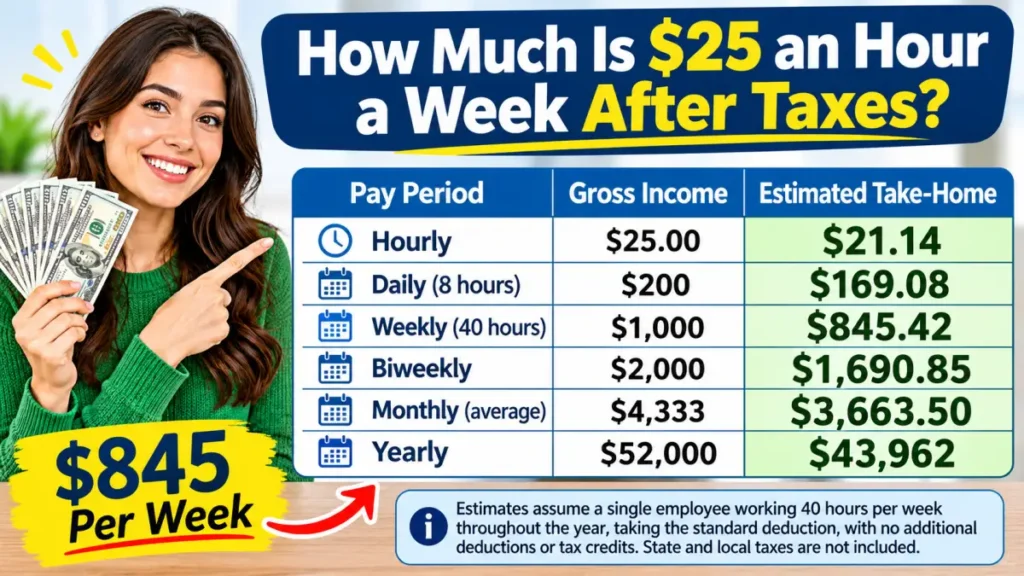
How Much Is $25 an Hour a Week After Taxes?
At $25 an hour, working 40 hours per week, you earn $1,000 before taxes. After estimated federal taxes and payroll deductions, your weekly take-home pay is approximately $845.
Here is what your earnings look like:
| Pay period | Gross income | Estimated take-home |
|---|---|---|
| Hourly | $25.00 | $21.14 |
| Daily (8 hours) | $200 | $169.08 |
| Weekly (40 hours) | $1,000 | $845.42 |
| Biweekly | $2,000 | $1,690.85 |
| Monthly (average) | $4,333 | $3,663.50 |
| Yearly | $52,000 | $43,962 |
Estimates assume a single employee working 40 hours per week throughout the year, taking the standard deduction, with no additional deductions or tax credits. State and local taxes are not included.
How Do You Calculate $25 an Hour Weekly Pay?
Calculating your weekly earnings is simple. Multiply your hourly wage by the number of hours you work.
For example:
- Hourly wage: $25
- Hours worked per week: 40
- Weekly gross income: $1,000
Calculation:
$25 × 40 = $1,000
This is your gross income, meaning the amount you earn before taxes and other deductions.
Your take-home pay is the money deposited into your bank account after applicable deductions. In our 2026 federal-only example, that amount is approximately $845 per week.

How Much Is $25 an Hour Monthly After Taxes?
If you earn $25 per hour and work 40 hours every week, your average monthly gross income is approximately $4,333.
After estimated federal taxes and payroll deductions, you could receive around $3,664 per month.
The monthly calculation uses your annual income divided by 12 because months do not all contain the same number of working weeks.
If you receive a biweekly paycheck, remember that most years have 26 pay periods. This means two months of the year may include three paychecks instead of two.
How Much Is $25 an Hour a Year After Taxes?
Working full-time at $25 an hour gives you an annual gross income of $52,000.
Here is the estimated annual breakdown for 2026:
| Income details | Amount |
|---|---|
| Annual gross income | $52,000 |
| Standard deduction | $16,100 |
| Estimated federal income tax | $4,060 |
| Social Security tax | $3,224 |
| Medicare tax | $754 |
| Total estimated taxes | $8,038 |
| Annual take-home pay | $43,962 |
This example assumes you are single, use the standard deduction, and have no additional taxable income or credits.
Your actual annual take-home income may be different if you live in a state that collects income tax or receive employer benefits.
What Taxes Are Taken Out of a $25 Hourly Paycheck?
Your paycheck usually includes several tax deductions. Understanding them helps explain why your take-home pay is lower than your hourly wage.
Federal income tax: This tax is based on your taxable income, filing status, and applicable federal tax brackets. Your W-4 information helps your employer determine how much to withhold.
Social Security tax: Employees generally pay 6.2% of eligible wages toward Social Security. This money helps fund retirement, disability, and survivor benefits.
Medicare tax: Employees generally contribute 1.45% of eligible wages toward Medicare.
State and local taxes: Depending on where you live, your paycheck may also include state and local income tax deductions.
You may also have deductions for health insurance, retirement contributions, or other workplace benefits.
Does $25 an Hour Include Overtime Pay?
No. Your regular $25 hourly wage does not automatically include overtime.
Under federal law, eligible nonexempt employees generally receive at least 1.5 times their regular hourly rate for hours worked beyond 40 in a workweek.
At $25 an hour, your standard overtime rate would be $37.50.
For example, if you work 45 hours in one week:
- Regular pay: 40 × $25 = $1,000
- Overtime pay: 5 × $37.50 = $187.50
- Total gross weekly income: $1,187.50
Your take-home pay will increase, although applicable taxes and deductions will still apply.

Is $25 an Hour Enough to Live On?
For some people, $25 an hour is a reasonable wage. For others, it may feel tight, especially in areas with expensive housing and transportation.
At 40 hours per week, your estimated federal-only monthly take-home pay is around $3,664.
Before deciding whether this wage meets your needs, consider your regular expenses:
- Rent or mortgage payments
- Groceries and household supplies
- Transportation and fuel
- Electricity, water, and internet
- Health insurance and medical expenses
- Savings and emergency funds
Someone living in a lower-cost area may find this income comfortable, while someone living in an expensive city may need to manage their spending more carefully. For more helpful information about budgeting, saving, and everyday financial decisions, explore our practical financial guides.
How to Calculate Your Exact Take-Home Pay
The easiest way to estimate your actual paycheck is to use an hourly paycheck calculator.
Enter your hourly wage, weekly working hours, state, filing status, and applicable deductions. The calculator can then provide a more personalized estimate.
Here are three useful resources:
- ADP Hourly Paycheck Calculator
- Salary Calculator After Taxes – $25 an Hour
- Maryland Salary Calculator – $25 an Hour
For the most accurate result, select the correct tax year and provide your actual employment and tax information.
Frequently Asked Questions
How much is $25 an hour for 40 hours a week after taxes?
At $25 an hour, you earn $1,000 per week before taxes. After estimated 2026 federal income tax, Social Security, and Medicare deductions, you could take home approximately $845 per week.
How much is $25 an hour biweekly after taxes?
Working 80 hours over two weeks gives you $2,000 in gross income. Your estimated federal-only take-home pay is approximately $1,691 every two weeks.
How much is $25 an hour for 30 hours a week?
If you work 30 hours per week at $25 an hour, your gross weekly income is $750. Your take-home pay will depend on your tax situation and deductions.
How much is $25 an hour for 20 hours a week?
Working 20 hours at $25 per hour gives you $500 in gross weekly earnings. Your actual take-home pay depends on applicable taxes and payroll deductions.
How much is $25 an hour for a year?
If you work 40 hours every week for 52 weeks, you earn $52,000 annually before taxes. Your estimated federal-only take-home income is approximately $43,962.
What is $25 an hour after taxes per day?
For an eight-hour workday, your gross income is $200. Using the same federal-only estimate, your average take-home pay is approximately $169 per day.
Can I make $25 an hour working part-time?
Yes. Your weekly earnings depend on how many hours you work. For example, 20 hours per week gives you $500 before taxes, while 30 hours gives you $750.
Final Thoughts
So, $25 an hour is approximately $845 a week after estimated federal taxes when you work 40 hours per week. That equals around $3,664 per month and $43,962 per year in take-home income under the assumptions used in this guide.
Remember that these are estimates, not guaranteed paycheck amounts. Your state taxes, filing status, insurance, and other deductions can change your final earnings. Understanding the difference between gross income and take-home pay will help you make smarter decisions about your job, expenses, and financial future.