Buying an established company can be an attractive alternative to starting from zero, but the financing needs are more complicated than simply borrowing the purchase price. If you are searching for a business acquisition loan in Monrovia, CA, you need to understand the available loan structures, qualification factors, cash requirements, and due-diligence issues before committing to a purchase.
For many qualifying acquisitions, an SBA 7(a) loan is an important option because the program allows financing for complete or partial changes of business ownership. The SBA currently lists a maximum 7(a) loan amount of $5 million.
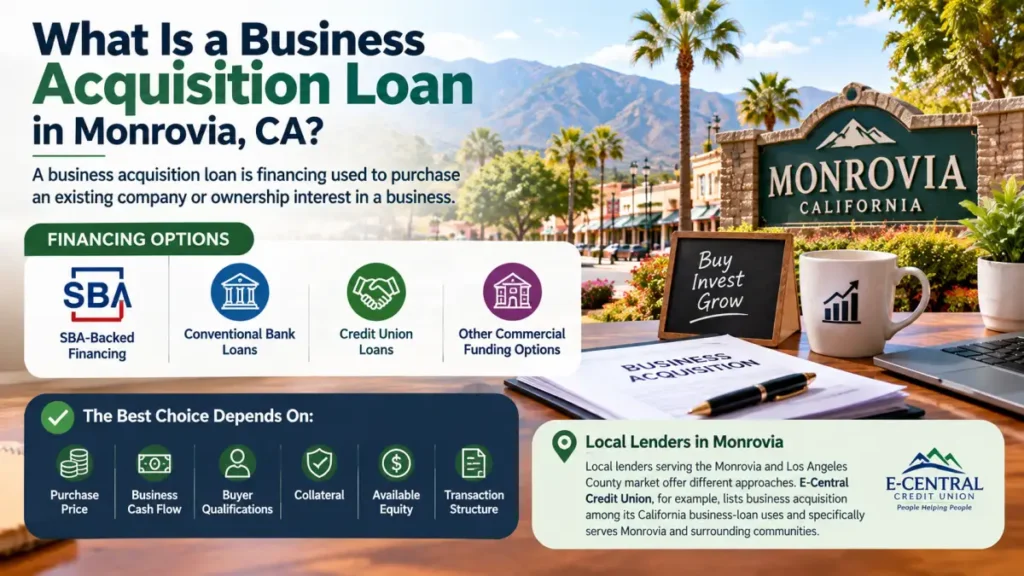
What Is a Business Acquisition Loan in Monrovia, CA?
A business acquisition loan is financing used to purchase an existing company or ownership interest in a business.
Direct answer: Buyers in Monrovia can consider SBA-backed financing, conventional bank or credit-union loans, and other commercial funding options. The best choice depends on the purchase price, business cash flow, buyer qualifications, collateral, available equity, and transaction structure.
Local lenders serving the Monrovia and Los Angeles County market offer different approaches. E-Central Credit Union, for example, lists business acquisition among its California business-loan uses and specifically serves Monrovia and surrounding communities. Learn more about what can fail a conventional loan appraisal before financing your purchase.
How Does a Business Acquisition Loan Work?
The process usually follows several stages:
- Identify the business and purchase price. Determine exactly what assets, contracts, inventory, equipment, or ownership interests are included.
- Review financial performance. Lenders examine revenue, profitability, tax returns, existing debt, and cash flow.
- Choose the financing structure. This may involve SBA financing, a conventional loan, buyer equity, or properly structured seller financing.
- Complete due diligence. Financial, legal, tax, operational, and lease information should be reviewed.
- Underwrite and close. The lender verifies repayment ability and other requirements before funding the transaction.
The central lending question is simple: Will the acquired business generate enough sustainable cash flow to repay the new debt while continuing to operate normally?
Why SBA 7(a) Financing Matters
Can an SBA loan be used to buy an existing business? Yes. SBA 7(a) proceeds can be used for complete or partial changes of ownership, as well as eligible working capital, equipment, real estate and other business purposes. The current maximum 7(a) loan amount is $5 million.
An SBA loan is not money lent directly by the government to the buyer. Instead, an approved lender makes the commercial loan under SBA program requirements, with an SBA guarantee supporting the lender.
This can make SBA financing worth comparing with conventional loans, particularly for an acquisition that requires longer-term financing.
However, SBA eligibility does not mean automatic approval. The lender still evaluates the buyer, the business, the transaction and the ability to repay.
What Can the Loan Pay For?
The exact permitted uses depend on the loan program and transaction, but acquisition financing may address several needs.
| Funding need | Potential purpose |
| Business purchase | Acquiring an eligible existing business |
| Working capital | Maintaining liquidity after closing |
| Equipment | Purchasing eligible machinery or equipment |
| Furniture and fixtures | Supporting the acquired operation |
| Real estate | Financing eligible business property |
| Certain refinancing | Replacing eligible existing business debt |
The SBA lists changes of ownership, working capital, equipment, furniture, fixtures, supplies and certain real-estate uses among 7(a) purposes.
The important point is that the purchase price is not the only cash requirement. Buyers should also consider post-closing working capital and transaction expenses.

How Much Money Do You Need Up Front?
There is no single cash requirement that applies to every business acquisition loan.
Your required cash contribution can depend on the lender, transaction structure, SBA requirements, business risk and your financial position.
Instead of asking only, “What is the minimum down payment?” calculate the complete cash requirement, including:
- Equity contribution
- Closing expenses
- Professional fees
- Working-capital reserves
- Initial operating expenses
- Equipment or improvements not financed
Using every available dollar to purchase the company can leave the new owner without enough liquidity to handle unexpected expenses.
How to Qualify for a Business Acquisition Loan
Lenders generally evaluate both the buyer and the business being acquired.
Buyer qualifications
Expect the lender to consider your credit history, financial resources, management experience and ability to operate the company.
Relevant industry experience can strengthen an application, particularly when the business depends heavily on specialized knowledge.
Business qualifications
The lender will usually want detailed information about the company’s financial performance, including tax returns and financial statements.
A profitable business is not automatically a good acquisition. The lender needs confidence that the reported earnings are sustainable after the ownership change and new debt payments.
Purchase-price reasonableness
The proposed price should make sense relative to the company’s financial performance, assets, customer base and future prospects.
A professional valuation may be appropriate for larger or more complicated transactions.
SBA vs. Conventional Business Acquisition Loans
Neither option is automatically better.
| Factor | SBA 7(a) | Conventional financing |
| Acquisition use | Specifically permitted | Depends on lender |
| Maximum SBA amount | $5 million | Varies |
| Government guarantee | SBA guarantee | Generally none |
| Requirements | SBA + lender requirements | Lender-specific |
| Best potential fit | Qualifying acquisitions needing SBA structure | Strong borrowers and established businesses |
Local lenders can offer additional structures. E-Central lists term loans, SBA loans, equipment loans, working-capital financing and commercial real-estate loans.
Beach Cities Commercial Bank likewise lists business acquisition loans, term loans and SBA 7(a) financing among its business-lending options.
Alternative financing providers may emphasize speed and shorter-term funding. For example, Monera Capital currently publishes business loans ranging from $10,000 to $500,000 with terms of three to 24 months.
These products should not automatically be treated as substitutes for long-term acquisition financing. Compare total repayment costs and structure carefully.
What to Check Before Buying a Monrovia Business
What should you investigate before taking an acquisition loan? Review the company’s financial records, debts, leases, customers, employees, equipment, licenses, contracts and legal obligations before committing to the purchase.
Pay particular attention to:
- Several years of financial statements and tax returns
- Revenue concentration
- Customer retention
- Existing liens or debts
- Lease terms and assignment rights
- Employee obligations
- Equipment condition
- Pending litigation
- Seller’s reason for selling
- Owner compensation
- One-time expenses
- Sustainable cash flow
Also determine whether the transaction is structured as an asset purchase or equity purchase. Tax treatment can differ significantly. For qualifying asset acquisitions, the IRS requires both buyer and seller to use Form 8594 when the applicable Section 1060 requirements are met. IIRS
A business attorney and tax professional should review the transaction before closing.
Example: A $900,000 Business Acquisition
Suppose you find an established Monrovia business listed for $900,000.
Rather than simply asking a lender for $900,000, build a complete sources-and-uses calculation.
Consider:
- Purchase consideration
- Buyer equity
- Loan proceeds
- Closing costs
- Working-capital needs
- Equipment requirements
- Seller financing, if applicable
The key question is whether the business can comfortably support the proposed debt while still paying employees, taxes, suppliers, rent and other operating expenses.
A lower purchase price does not necessarily mean a safer acquisition. Cash flow and liquidity matter just as much as the headline price.
Common Mistakes to Avoid
- Focusing only on the purchase price: Include working capital and transaction costs.
- Assuming SBA approval is automatic: The lender still conducts underwriting.
- Using all your cash at closing: Preserve reasonable operating liquidity.
- Ignoring the lease: Location-dependent businesses can be heavily affected by lease terms.
- Relying entirely on seller-provided numbers: Compare financial statements with tax returns and bank records.
- Comparing loans only by interest rate: Review fees, repayment period, collateral, prepayment provisions and total borrowing costs.
Frequently Asked Questions
Can I get a business acquisition loan in Monrovia, CA?
Yes. Buyers can explore SBA-backed, conventional bank, credit-union and other commercial financing options. E-Central Credit Union specifically lists Monrovia among the Southern California communities it serves.
Can an SBA 7(a) loan buy an existing business?
Yes. Complete and partial changes of ownership are permitted uses of SBA 7(a) financing, subject to applicable SBA and lender requirements.
What credit score is required?
There is no single SBA-wide credit-score number that guarantees approval. Lenders evaluate credit history together with cash flow, repayment ability, equity, collateral and other factors.
How long does acquisition financing take?
Timing varies by lender and transaction complexity. A straightforward application with complete documentation may move faster than a transaction involving real estate, multiple entities, complex ownership or extensive due diligence.
Do I need a business plan?
Requirements vary by lender, but a strong acquisition plan can help explain the purchase, management transition, financing structure and projected cash flow.
Can I finance working capital along with the acquisition?
Potentially, yes. SBA 7(a) financing permits eligible working-capital uses, but the amount and structure must satisfy SBA and lender requirements.
Conclusion
A business acquisition loan in Monrovia, CA should be evaluated as part of the entire acquisition—not simply as a way to cover the seller’s asking price.
For qualifying buyers, SBA 7(a) financing can be particularly relevant because business ownership changes are an eligible use. Conventional loans and other financing structures may also make sense depending on the buyer and target company’s financial strength.
Before signing, compare the complete financing cost, required equity, repayment terms, collateral requirements and post-closing liquidity. Most importantly, make sure the acquired business can realistically support its new debt.