Canadian stocks have gained attention following the 2026 US midterm elections, as investors consider whether political changes in Washington could lead to softer trade policies toward Canada. The S&P/TSX Composite Index climbed 2.3% the day after the election, raising hopes that reduced tariff pressure and improving Canada-US relations could support Canadian businesses.
However, a stronger stock market does not mean the trade dispute is over. Investors are still watching President Donald Trump, Prime Minister Mark Carney, and upcoming trade negotiations for signs of lasting progress. Investors following these developments should also understand broader stock market trends and investor sentiment, particularly how economic reports and Federal Reserve decisions influence equity prices.

Why Are Canada Stocks Rising After the US Midterm Elections?
The US midterm elections have created fresh expectations for Canada’s financial markets. Democrats made significant gains, taking control of Congress and increasing political pressure on the Trump administration’s tariff policies.
For Canadian companies, the election results matter because the United States remains Canada’s largest trading partner. Businesses in manufacturing, automotive production, steel, agriculture, and energy depend heavily on cross-border trade.
According to recent market reports, the S&P/TSX Composite gained 2.3% in the session following the November 3 election. The index also outperformed the S&P 500 over the period immediately following the vote.
Investors interpreted the political results as a possible sign that Washington could reconsider some trade restrictions.
Still, market optimism is based on expectations rather than a confirmed trade agreement. The actual direction of Canadian stocks will depend on economic conditions, corporate earnings, and decisions made by both governments.
How US Tariffs Are Affecting Canada’s Stock Market
Tariffs have become one of the biggest concerns for Canadian businesses and investors in 2026.
The Trump administration introduced additional duties on selected Canadian products, creating uncertainty for companies that rely on American customers and suppliers. Canada also introduced counter-tariffs on certain US imports.
These measures can increase production costs, reduce profit margins, and make cross-border supply chains more expensive.
The automotive industry is particularly exposed because Canadian and American manufacturers share production facilities, suppliers, and transportation networks.
Steel producers and other manufacturers also face challenges when tariffs make their products less competitive in international markets.
For investors, the biggest concern is not simply the cost of tariffs today. It is the possibility that trade restrictions could remain in place for an extended period.
Carney and Trump Trade Talks Bring Fresh Market Optimism
Developments between Mark Carney and Donald Trump have become another important factor for Canadian stocks.
On November 14, Carney said Canada and the United States were making progress toward a possible trade agreement following substantive discussions with Trump. However, he did not announce a completed agreement or provide a confirmed timeline.
This development has encouraged investors who believe improved diplomatic relations could eventually reduce trade uncertainty.
Earlier disagreements had interrupted negotiations in August. Differences over tariffs, industrial policy, and Canadian cultural protections created additional obstacles.
Recent discussions suggest that both governments remain interested in finding common ground, although important issues still need to be resolved.
The main question for investors is whether these discussions will produce practical changes to existing tariffs.
A limited agreement could provide relief to selected industries without resolving every trade dispute between the two countries.

Which Canadian Stock Market Sectors Could Benefit From Lower Tariffs?
Not every Canadian industry has the same exposure to US trade policy. Some companies depend heavily on cross-border business, while others are influenced more by commodity prices and domestic demand.
The following sectors are worth watching as trade discussions continue.
| Sector | Potential impact of tariff relief | Why it matters |
| Automotive | Positive | Lower trade costs could support vehicle and parts manufacturers. |
| Steel | Positive | Reduced duties could improve access to US customers. |
| Energy | Mixed | Trade relations matter, but oil and gas prices remain major drivers. |
| Agriculture | Positive | Easier market access could support Canadian exporters. |
| Financials | Indirect | Greater economic confidence could support lending and investment activity. |
| Technology | Indirect | Improved business confidence may encourage investment and spending. |
Automotive Companies
Automotive manufacturers are among the businesses most exposed to Canada-US trade tensions.
Companies such as Magna International and Linamar operate within closely connected North American supply chains.
Lower tariffs could reduce costs and improve the competitiveness of Canadian automotive production. However, the benefits would depend on the final terms of any agreement.
Steel and Manufacturing
Canadian steel producers could also benefit if Washington reduces duties on imported Canadian steel.
Tariff relief may improve export opportunities and provide manufacturers with greater confidence when planning production and investment.
Energy and Financial Stocks
Energy companies have their own market drivers, including oil prices, demand, and global supply conditions.
Canadian banks and financial institutions may benefit indirectly if improved trade relations strengthen business confidence and economic activity.
Canada Stocks vs US Stocks: Key Differences After the Midterms
The recent political developments have created different investment expectations for Canadian and American markets.
| Comparison | Canadian Stocks | US Stocks |
| Main index | S&P/TSX Composite | S&P 500 |
| Election impact | Hopes for improved trade relations | Political pressure on tariff policy |
| Important sectors | Energy, materials, financials | Technology, healthcare, financials |
| Tariff exposure | Canadian exporters face US duties | American businesses face supply-chain costs |
| Main opportunity | Potential trade relief | Greater trade policy certainty |
| Main risk | Continued Canadian-US trade tensions | Inflation and political uncertainty |
The TSX’s stronger performance immediately after the election reflects investor expectations, but it does not establish that Canadian stocks will outperform US shares over the long term.
Both markets have different sector compositions and economic influences.
Will US Midterm Election Results End Trump’s Tariffs on Canada?
Not necessarily.
Although Democrats gained control of Congress, the US president still has significant authority over trade policy. Congress can investigate tariffs, introduce legislation, and increase political pressure, but removing existing restrictions is not always straightforward.
Prime Minister Carney has also indicated that the Trump administration will remain the central decision-maker in Canada-US trade negotiations.
This means Canadian businesses should not assume that the election results will automatically bring an end to tariffs.
A negotiated agreement between Ottawa and Washington could provide a more immediate path toward tariff relief than relying entirely on congressional action.
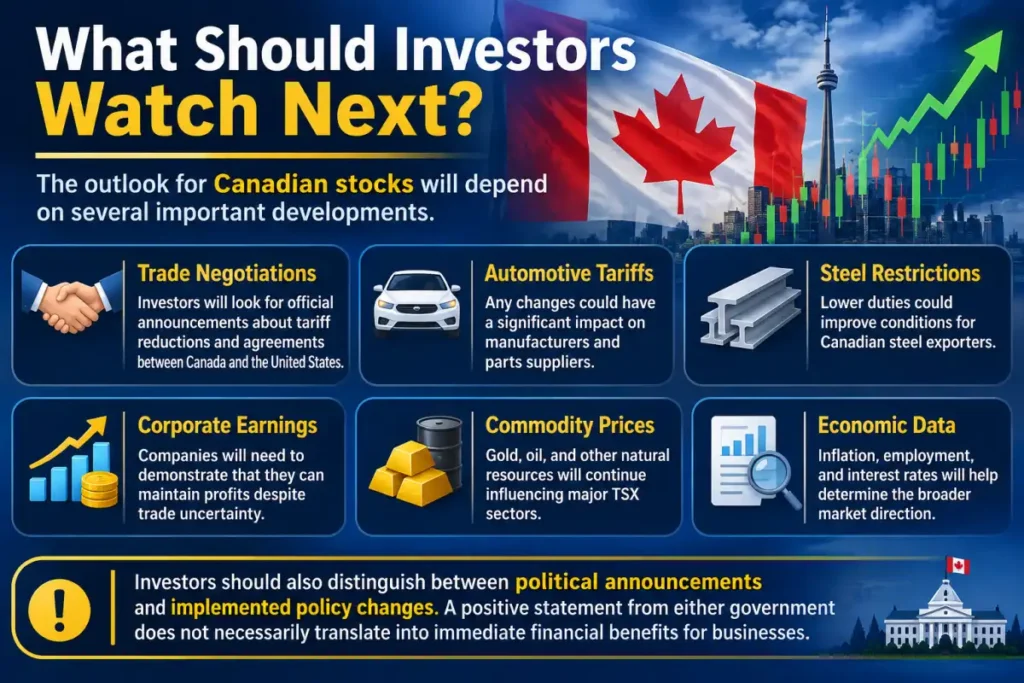
What Should Investors Watch Next?
The outlook for Canadian stocks will depend on several important developments.
- Trade negotiations: Investors will look for official announcements about tariff reductions and agreements between Canada and the United States.
- Automotive tariffs: Any changes could have a significant impact on manufacturers and parts suppliers.
- Steel restrictions: Lower duties could improve conditions for Canadian steel exporters.
- Corporate earnings: Companies will need to demonstrate that they can maintain profits despite trade uncertainty.
- Commodity prices: Gold, oil, and other natural resources will continue influencing major TSX sectors.
- Economic data: Inflation, employment, and interest rates will help determine the broader market direction.
Investors should also distinguish between political announcements and implemented policy changes. A positive statement from either government does not necessarily translate into immediate financial benefits for businesses. Before making investment decisions during periods of political and economic uncertainty, readers should understand important investing principles and market risks.
Frequently Asked Questions (FAQs)
1. Why are Canadian stocks rising after the US midterm elections?
Canadian stocks gained after Democrats made significant gains in the US midterms. Investors believe increased political pressure could encourage the Trump administration to reconsider some tariffs affecting Canadian businesses.
2. How did the TSX Composite perform after the 2026 US midterms?
The S&P/TSX Composite Index rose 2.3% in the session following the November 3 election, according to reported market coverage. The move reflected improved investor sentiment about potential changes in US trade policy.
3. Will US midterm elections remove tariffs on Canadian goods?
No automatic tariff removal follows from the election results. Democrats can challenge trade policies through legislation and congressional oversight, but the president retains important trade powers.
4. What Canadian stocks could benefit from lower US tariffs?
Automotive and manufacturing companies, including Magna International and Linamar, could benefit from reduced cross-border trade costs. Steel producers and other exporters may also gain from improved market access.
5. What is Mark Carney saying about Canada-US trade negotiations?
Carney said on November 14 that Canada and the United States were making progress toward a possible trade agreement after substantive discussions with Donald Trump. However, no final agreement had been announced.
6. Is the Canadian stock market a good investment after the midterms?
The election results have improved short-term market sentiment, but they do not guarantee future returns. Investors should consider company fundamentals, valuations, economic conditions, and trade policy risks before making investment decisions.
Final Thoughts
The relationship between Canada stocks, US midterms, and tariffs is becoming an important story for investors in 2026. Democratic gains in Congress have raised expectations of greater political pressure on Trump’s trade policies, while renewed discussions between Carney and Trump have added another reason for cautious optimism.
However, the long-term outlook will depend on actual trade agreements rather than election results alone. Until tariff policies become clearer, Canadian investors should pay attention to corporate earnings, industry exposure, and broader economic developments.
For now, the TSX’s recent performance shows that investors are responding positively to the possibility of improved Canada-US trade relations, but uncertainty remains.