Quick Answers
What is a collective investment scheme in Singapore?
It is an investment arrangement in which participants invest in collectively managed property, rather than having day-to-day control over the assets themselves. Contributions or investment returns may be pooled in accordance with the scheme’s structure.
What is a Singapore collective investment scheme?
It is generally used for a CIS that has been established or provided under Singapore’s regulatory framework. Depending on the situation, a locally established scheme might need to be authorised, and an overseas scheme might need to be recognised, and/or there might be an applicable exemption.
What is collective investment scheme Singapore regulation?
The framework is principally supported by the Securities and Futures Act and MAS’s Code on Collective Investment Schemes, as well as relevant subsidiary legislation and regulatory requirements. The exact requirements depend on the scheme and how it is offered.
How does a collective investment scheme work in Singapore?
Investors contribute capital to a common investment arrangement, and the fund’s assets are managed according to its stated strategy. Investors typically receive units or another interest whose value can change as the underlying investments change.
Are collective investment schemes in Singapore safe?
No investment should be described as completely safe. Regulatory requirements can provide important investor protections, but a CIS remains exposed to investment, market, liquidity and other risks. Investors should read the relevant documents and assess whether the product suits their circumstances.
Introduction
If you are searching for collective investment schemes in Singapore, the basic idea is straightforward: a CIS allows multiple investors to contribute money or assets to a collectively managed investment arrangement. Investors generally receive units or another form of interest in the scheme, while a professional manager makes investment decisions in accordance with the fund’s objectives.
The framework comes hand in hand with two other pieces of legislation, namely the Securities and Futures Act (SFA) and the Monetary Authority of Singapore (MAS), as well as the Code on Collective Investment Schemes in Singapore. But it is not guaranteed that all CIS will be available to all investors, or that they will have the same requirements.

What Is a Collective Investment Scheme?
A collective investment scheme definition Singapore readers should know is based on an arrangement involving property where participants do not have day-to-day control over its management. The property may be managed as a whole by or for the manager, and investors’ contributions or investment income may be pooled.
Put simply, instead of each investor choosing and managing every asset independently, investors participate in a common investment structure.
For example, imagine a fund receives S$10 million from 1,000 investors. The fund manager could use that pooled capital to purchase shares, bonds or other permitted investments. Each investor’s return depends on the performance of the investments and the terms of the fund.
CIS structures can include different types of investment products. The appropriate structure depends on factors such as the assets, investor group, legal structure and distribution strategy. Understanding a collective investment scheme is only one part of making better financial decisions. Good personal financial management can help you assess your goals, available capital and tolerance for investment risk before choosing an investment product.
How Does a Singapore Collective Investment Scheme Work?
A Singapore collective investment scheme normally has several important participants. Investors provide capital, the fund manager manages the portfolio, and other service providers may handle custody, administration, valuation and compliance.
For many schemes, investors receive units representing their interest in the fund. The value of those units can rise or fall depending on the value of the underlying assets.
Consider a hypothetical fund with assets worth S$5 million and 500,000 units. If the relevant valuation produces a net asset value (NAV) of S$10 per unit, an investor holding 1,000 units has an investment valued at S$10,000 before applicable fees or other adjustments.
NAV simply means the value of the fund’s assets minus its liabilities, divided according to the fund’s valuation methodology.
The important point is that pooled investing does not remove investment risk. A fund holding shares can fall when equity markets decline, while a bond-focused fund can be affected by interest rates, credit risk and other factors.
How Is a CIS Regulated in Singapore?
The collective investment scheme code in the Singapore framework is primarily built around the SFA and the MAS Code on Collective Investment Schemes. The Code sets requirements and guidelines relevant to areas such as investment management and fund operations.
For a Singapore-established CIS that is offered under the regulated public framework, authorisation by MAS may be required. A foreign scheme offered in Singapore may require MAS recognition, depending on its structure and how it is offered.
This distinction matters because “regulated fund” does not automatically mean every scheme follows the same route.
MAS also maintains public systems where investors can check information about authorised and recognised schemes and their offering documents.
Authorised, Recognised and Restricted Schemes
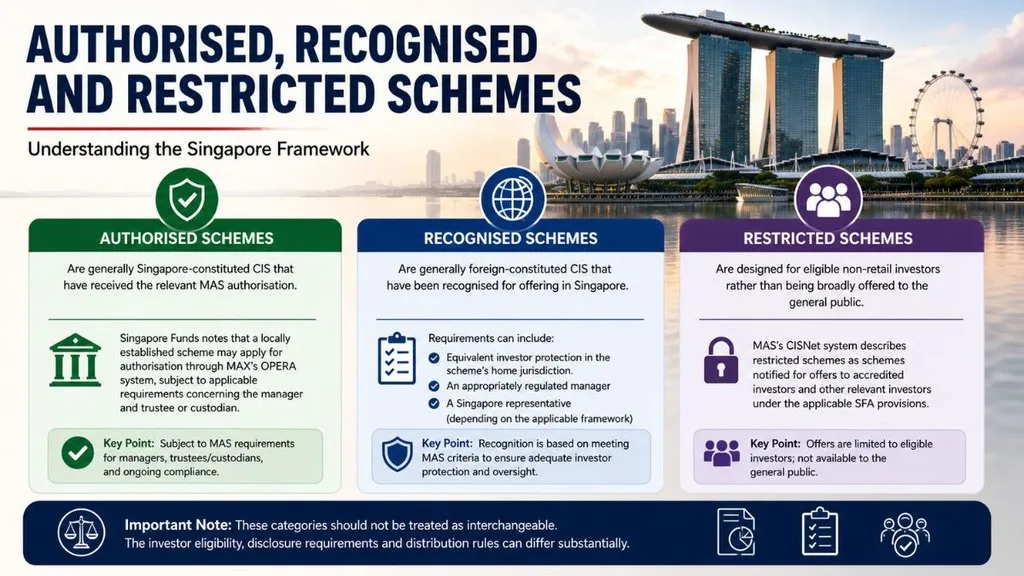
One of the easiest ways to understand the Singapore framework is to separate three common categories.
Authorised schemes are generally Singapore-constituted CIS that have received the relevant MAS authorisation. Singapore Funds notes that a locally established scheme may apply for authorisation through MAX’s OPERA system, subject to applicable requirements concerning the manager and trustee or custodian.
Recognised schemes are generally foreign-constituted CIS that have been recognised for offering in Singapore. Requirements can include equivalent investor protection in the scheme’s home jurisdiction, an appropriately regulated manager and a Singapore representative, depending on the applicable framework.
Restricted schemes are designed for eligible non-retail investors rather than being broadly offered to the general public. MAS’s CISNet system describes restricted schemes as schemes notified for offers to accredited investors and other relevant investors under the applicable SFA provisions.
These categories should not be treated as interchangeable. The investor eligibility, disclosure requirements and distribution rules can differ substantially.
What Are Exempt Offers?
Not every CIS offer requires the same authorisation or recognition process. Singapore’s framework contains exemptions subject to specific conditions.
Examples can include certain offers to institutional investors, restricted schemes for eligible investors, private placements and qualifying small offers. Singapore Funds identifies, among others, private placements involving no more than 50 persons within 12 months and a small-offer exemption subject to a S$5 million threshold over the relevant period.
These exemptions are conditional. An exemption from one regulatory requirement does not mean an investment product is generally free from regulation.
For investors, this distinction is particularly important. A product marketed privately or only to eligible investors may have different disclosure and distribution characteristics from a publicly offered fund.
What Are the Benefits of a CIS?
The main attraction of a CIS is pooled investing. Investors can gain access to a professionally managed portfolio without having to select and manage every underlying asset themselves.
Potential advantages include:
- Diversification: A fund may spread investments across different companies, securities, sectors or markets.
- Professional management: Investment decisions are generally made by a manager in accordance with the fund’s strategy.
- Accessibility: Some funds allow investors to participate with less capital than would be needed to build a comparable portfolio independently.
- Operational convenience: Administration, valuation and other fund functions are handled within the scheme’s structure.
However, these advantages are not guarantees of superior performance. Diversification can reduce concentration risk, but it cannot eliminate losses. The framework is principally supported by the Securities and Futures Act and MAS’s Code on Collective Investment Schemes.
What Risks Should Investors Understand?
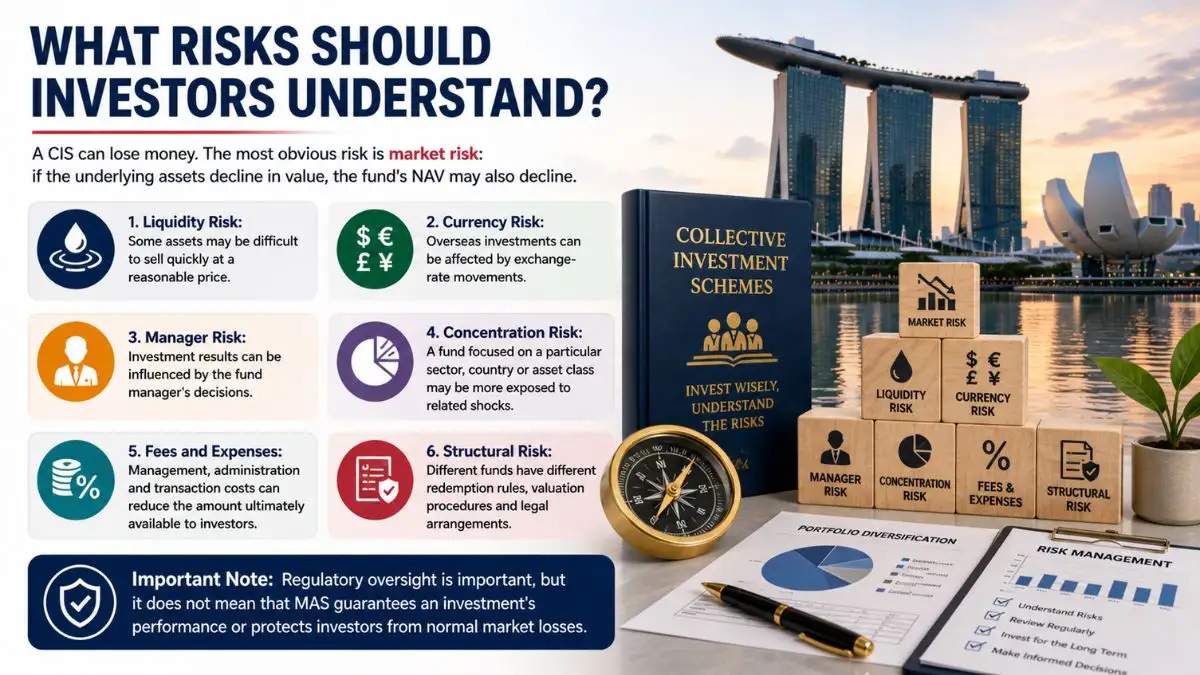
A CIS can lose money. The most obvious risk is market risk: if the underlying assets decline in value, the fund’s NAV may also decline.
Other risks can include:
- Liquidity risk: Some assets may be difficult to sell quickly at a reasonable price.
- Currency risk: Overseas investments can be affected by exchange-rate movements.
- Manager risk: Investment results can be influenced by the fund manager’s decisions.
- Concentration risk: A fund focused on a particular sector, country or asset class may be more exposed to related shocks.
- Fees and expenses: Management, administration and transaction costs can reduce the amount ultimately available to investors.
- Structural risk: Different funds have different redemption rules, valuation procedures and legal arrangements.
Regulatory oversight is important, but it does not mean that MAS guarantees an investment’s performance or protects investors from normal market losses.
What Should Beginners Check Before Investing?
Before buying units in any collective investment scheme, Singapore investors should examine the offering documents themselves rather than relying solely on advertisements or summaries.
Start by checking:
- Investment objective: What is the fund trying to achieve?
- Underlying assets: What will your money actually be invested in?
- Risk factors: What could cause the investment to lose value?
- Fees: Look beyond the headline management fee and understand other applicable charges.
- Liquidity: Find out when and how you can redeem your investment.
- Fund manager: Consider the manager’s regulatory status and experience.
- Offering documents: Review the prospectus, product highlights sheet or applicable information memorandum.
- Regulatory status: Where relevant, check MAS’s public CIS records.
A useful rule is to understand the investment before focusing on its past returns. Historical performance can provide context, but it does not guarantee future results.
What Is a Collective Investment Scheme Singapore Investors Can Actually Verify?
The easiest answer is in the public information available from MAS. Its CIS portal provides searchable information on schemes, including authorised and recognised schemes, while its prospectus system provides access to registered offering documents for applicable schemes.
That gives investors a practical starting point: identify the fund, check its regulatory status where applicable, and then read the relevant documents.
A hypothetical example illustrates why this matters. Suppose two funds advertise similar investment strategies. One may be publicly offered under a recognised or authorised framework, while another may be available only to eligible investors under an exemption. The products may have very different eligibility, disclosure and liquidity characteristics even though their investment themes sound similar.
FAQ’s
Is a mutual fund a collective investment scheme?
Many mutual fund structures fall under the broad concept of a collective investment scheme because investors pool their money in a collectively managed arrangement. The exact legal classification depends on the structure and applicable Singapore law.
Does every CIS need MAS approval?
No. Some schemes may be authorised or recognised, while qualifying offers can rely on specific exemptions. The applicable route depends on factors such as where the scheme is established and who is being offered the investment.
Can retail investors invest in restricted schemes?
Generally, restricted schemes are intended for eligible non-retail investors rather than the general retail public. Investor eligibility and applicable conditions should be checked for the specific offering.
Where can I check a CIS in Singapore?
MAS provides public search facilities for collective investment schemes and prospectuses. Investors can use these resources to check relevant schemes and offering-document information.
Does MAS guarantee CIS returns?
No. Regulatory oversight does not guarantee investment returns or eliminate market losses. Investors remain responsible for understanding the risks of the particular fund.
Final Takeaway
A collective investment scheme in Singapore is best understood as a structured way for investors to participate in pooled investments managed according to defined rules. The Singapore framework distinguishes between authorised, recognised, restricted and exempt offerings, so the regulatory label and investor eligibility matter.
For beginners, the most useful approach is simple: understand what the fund owns, who manages it, what it costs, how you can exit, what could go wrong, and what regulatory status applies. That gives you a much stronger basis for comparing investment products than looking at returns alone.