Quick Answers
Is $500,000 Enough to Work With a Financial Advisor?
Yes, $500,000 can be enough to work with a financial advisor, but there is no universal minimum. Some advisors work with clients below that amount, while others have minimum asset requirements.
The better question to ask is if the advisor’s services are worth the money and if they are solving issues that you can’t handle on your own. When considering a hire, inquire about minimums, fees, services, conflicts of interest, and if the relationship encompasses investment management, financial planning or both.
Who Do Billionaires Use to Manage Their Money?
Billionaires don’t depend on one person, they use professionals. That team can consist of investment managers, tax advisors, lawyers, accountants and family-office experts, depending on their situation.
The important lesson for ordinary investors is not to copy a billionaire’s exact structure. Their financial situations can involve businesses, trusts, international assets, complex tax arrangements and estate-planning needs that most households do not have.
What Is the 7-7-7 Rule for Money?
There is no single universally accepted “7-7-7 rule” in personal finance. Different websites use the phrase for different budgeting or savings concepts, so it should not be treated as an established financial standard.
A better approach is to use measurable targets based on your income, expenses, emergency needs, debt and financial goals rather than following an unexplained formula.
Introduction
Managing money becomes harder when your finances are spread across bank accounts, investments, property, retirement accounts, vehicles and other valuable possessions. Personal asset management brings those pieces together so you can understand what you own, what you owe, how your wealth is changing and whether your financial decisions support your goals.
It is not limited to wealthy investors. A simple system can help almost anyone build a clearer picture of their financial position.

What Is Personal Asset Management?
Personal asset management involves the identification, organisation, tracking and management of assets owned, along with the consideration of liabilities, financial objectives and risk. This may encompass regular savings, investments, property, retirement accounts and valuable personal possessions.
For example, imagine you have $15,000 in savings, $20,000 invested in funds, a $150,000 home and a car worth $12,000. Those are assets. If you also have a $100,000 mortgage and $5,000 of other debt, those liabilities need to be considered when assessing your overall financial position.
This is why asset management is broader than simply picking stocks. It is about understanding the complete financial picture.
What Counts as a Personal Asset?
Personal assets are things you own that have financial or economic value. Some are easy to value, while others require estimates or professional valuations.
Common examples include:
- Cash and savings accounts
- Stocks, bonds, ETFs and mutual funds
- Retirement and pension accounts
- Real estate
- Business interests
- Vehicles
- Jewellery, artwork and collectibles
- Certain digital assets
Your liabilities are equally important. Mortgages, credit-card balances, student loans, personal loans and other debts reduce your net worth.
Net worth = Total assets − Total liabilities.
If your assets are worth $300,000 and your liabilities total $120,000, your hypothetical net worth is $180,000.
Tracking this number over time can be more informative than looking at one investment account in isolation.
How Does Personal Asset Management Work?
A useful personal asset management system generally follows five steps.
1. Create an inventory. List your financial and valuable physical assets, including approximate values, account information and ownership details.
2. Record liabilities. Add mortgages, loans, credit-card balances and other obligations.
3. Define your goals. Your priorities might include buying a home, funding education, building retirement savings or preserving wealth.
4. Assess risk and allocation. Asset allocation means deciding how much of your investment portfolio is held in categories such as stocks, bonds and cash. The appropriate mix depends on your time horizon and risk tolerance.
5. Review and update. Asset values, debts, income and goals change. A review every few months—or whenever there is a major financial change—can keep your records useful.
This approach turns scattered financial information into a system you can actually use.
Why Personal Asset Management Matters
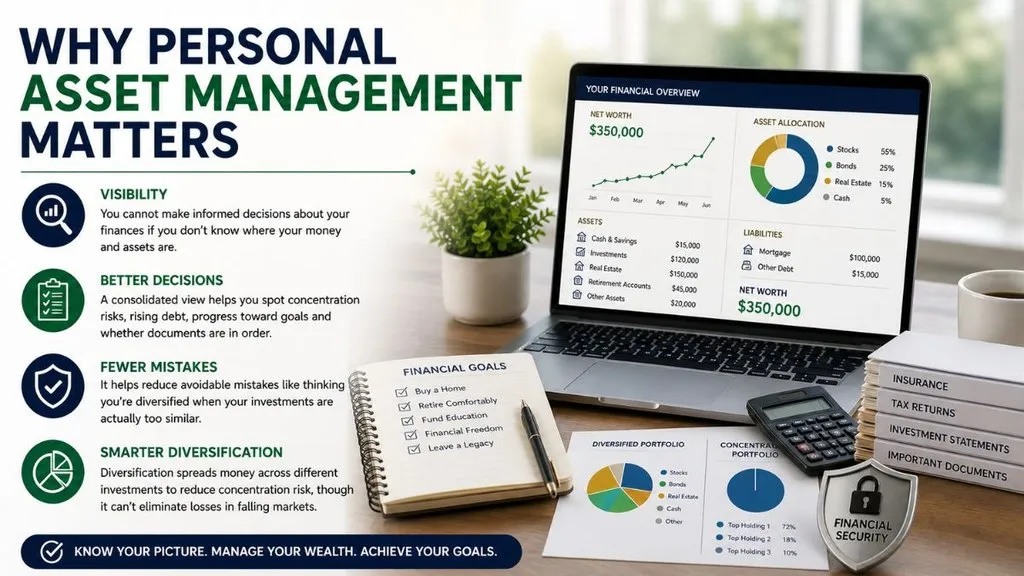
The main benefit is visibility. You cannot make informed decisions about your finances if you do not know where your money and assets are.
A consolidated view can help you identify whether too much of your wealth is concentrated in one investment, whether debt is increasing, whether you are making progress toward a goal and whether important documents are organised.
It can also reduce avoidable mistakes. For instance, someone might believe they are well diversified because they own several funds, only to discover that many of those funds hold the same companies.
Diversification spreads money among different investments to reduce concentration risk, although it cannot eliminate losses when markets fall.
Personal Asset Management Software vs. Doing It Yourself
Personal asset management software can make tracking easier, but you do not necessarily need specialized software. A spreadsheet can be enough for someone with a small number of accounts and straightforward finances.
More comprehensive personal asset management software may allow you to:
- Track assets and liabilities in one place
- Monitor investment values
- Calculate net worth
- Store financial documents
- Organise property and other possessions
- Generate reports
- Track changes over time
MyAssets, for example, describes a platform that combines financial, property, digital and physical asset tracking with document storage and net-worth calculations.
The right tool depends on complexity. Avoid paying for features you will not use, and carefully review security, privacy, account-access permissions and data-export options before connecting financial information to any third-party service.
When Should You Consider a Personal Asset Management Company?
A personal asset management company or financial professional may be useful when your finances become difficult to manage yourself. This can happen after receiving an inheritance, selling a business, approaching retirement or accumulating investments across multiple accounts.
Professional services can include portfolio construction, investment management, financial planning, tax-aware decisions and ongoing monitoring.
However, compare costs and services carefully. Some professionals charge asset-based fees, while others may use hourly, flat-fee or commission arrangements. Ask exactly how the professional is compensated and what conflicts of interest could exist.
In the United States, investment advisers have fiduciary duties under the Investment Advisers Act, while broker-dealers operate under Regulation Best Interest when making covered recommendations. These standards are not identical, so understanding the professional’s role matters.
Risks and Common Mistakes
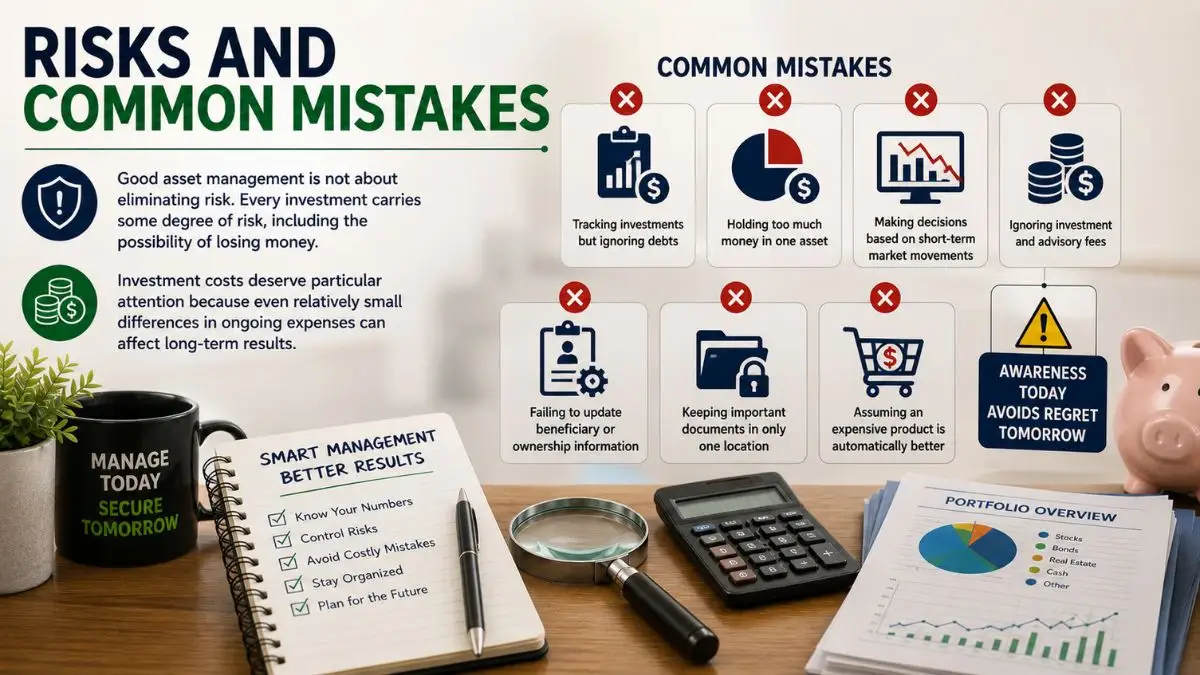
Good asset management is not about eliminating risk. Every investment carries some degree of risk, including the possibility of losing money.
Common mistakes include:
- Tracking investments but ignoring debts
- Holding too much money in one asset
- Making decisions based on short-term market movements
- Ignoring investment and advisory fees
- Failing to update beneficiary or ownership information
- Keeping important documents in only one location
- Assuming an expensive product is automatically better
Investment costs deserve particular attention because even relatively small differences in ongoing expenses can affect long-term results.
Who Are the Big Three Asset Managers?
The “Big Three” traditionally refers to BlackRock, Vanguard and State Street. They became especially prominent through their enormous presence in index funds and ETFs and are among the largest institutional shareholders in major public companies.
This should not be confused with personal asset management. These companies primarily manage investments for funds and institutional or individual investors; they are not simply personal financial managers for wealthy households.
A Simple Personal Asset Management Plan
You can start without expensive software or a professional advisor.
Create one document containing your major assets, current estimated values, debts, account locations and important financial documents. Then calculate your approximate net worth.
Next, review your investments. Ask whether your asset allocation fits your time horizon and risk tolerance. If your portfolio has drifted substantially from your intended allocation, rebalancing may be appropriate.
Finally, establish a review schedule. A simple quarterly check can help you catch outdated valuations, unnecessary fees, rising debt or missing documents before they become bigger problems.
The goal is not to constantly change your investments. It is to understand your financial position well enough to make deliberate decisions.
Frequently Asked Questions
What is the difference between asset management and wealth management?
Asset management generally focuses on managing investments and other assets. Wealth management is broader and may include investment management, retirement planning, tax planning, estate planning and other financial services.
How often should I review my personal assets?
A quarterly review is a reasonable starting point for many people. You should also review your information after major events such as buying property, changing jobs, receiving an inheritance or taking on significant debt.
Do I need personal asset management software?
No. A spreadsheet can work well if your finances are simple. Software becomes more useful when you have numerous accounts, investments, properties, documents or other assets to track.
Should my car be included in my net worth?
Yes, a vehicle is an asset and can be included using a reasonable current-value estimate. However, remember to include any outstanding auto loan as a liability.
Can personal asset management eliminate investment risk?
No. It can help you understand and manage risk, but it cannot prevent investment losses. Diversification, appropriate asset allocation and careful decision-making can reduce certain risks but cannot guarantee positive returns.
Conclusion
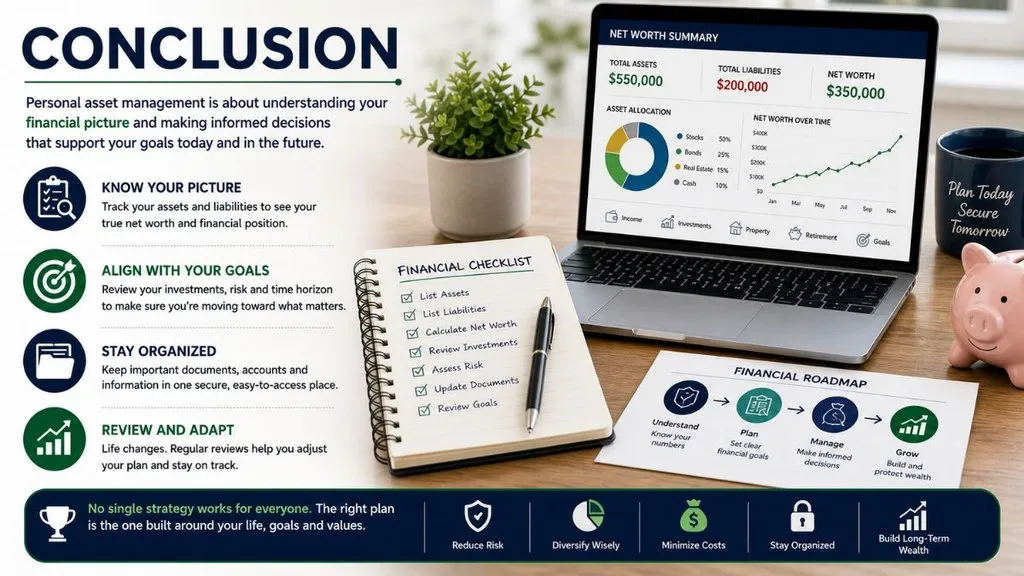
Personal asset management is essentially about knowing what you own, what you owe and how those pieces fit your financial goals. For beginners, the best system is usually the one you can maintain consistently.
Start with an asset and liability inventory, calculate your net worth, review your investment risk and keep important information organised. As your finances become more complicated, software or professional guidance may provide additional value.
There is no single asset-management strategy that works for everyone. Your income, goals, time horizon, risk tolerance, taxes and financial responsibilities all matter. The stronger your financial information and organisation, the easier it becomes to make decisions based on your actual circumstances rather than guesswork.
Pingback: Insurance Broker in Miami: What They Do and How to Choose One