Choosing between a flat dollar amount and a percentage of net pay depends on how you want to manage your money. A flat amount gives you a fixed contribution every payday, while a percentage automatically changes according to your take-home pay. Understanding both options can help you manage your paycheck, build savings, and plan for the future.

What Is a Flat Dollar Amount?
A flat dollar amount is a fixed sum of money that stays the same regardless of changes in your paycheck. When you select this option, you decide exactly how much money should go toward a particular account or financial goal.
For example, suppose your take-home pay is $3,000 per month and you decide to save $300. That $300 remains the same even if your monthly income increases or decreases.
This approach is useful for people who prefer predictable savings and want to maintain a consistent amount for specific expenses. Many employers and banks allow employees to divide their paycheck using a fixed dollar amount, a percentage, or the remaining balance. If you want to understand how paycheck deposit amounts work, read this guide on choosing how much of your paycheck is deposited.
Benefits of a flat dollar amount:
- Makes monthly budgeting easier.
- Provides predictable savings contributions.
- Helps you plan around fixed expenses.
- Gives you greater control over a specific savings target.
However, a fixed amount does not automatically increase when your income grows. You may need to adjust it manually to keep your savings progress on track.
What Does Percentage of Net Pay Mean?
Percentage of net pay means allocating a specific portion of your take-home income instead of choosing a fixed amount.
Net pay is the money you receive after taxes and other payroll deductions have been taken out.
For example, if your monthly net pay is $3,000 and you choose to save 10%, your savings contribution will be $300. If your take-home pay increases to $4,000, your contribution automatically becomes $400.
This method allows your savings to grow alongside your income without requiring you to change the amount every time your paycheck changes.
It can be particularly helpful for employees who receive raises, overtime payments, bonuses, or varying monthly earnings.
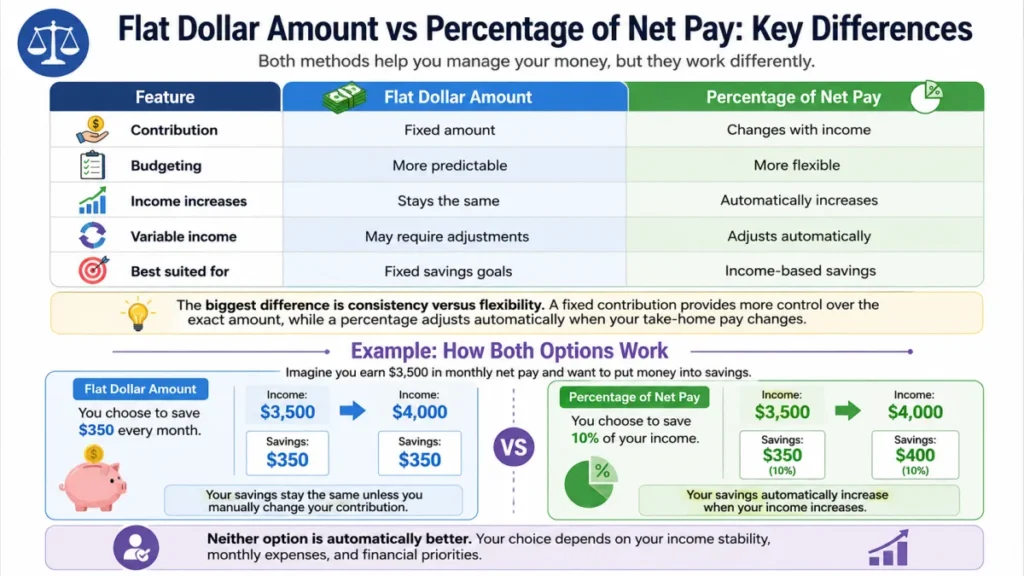
Flat Dollar Amount vs Percentage of Net Pay: Key Differences
Both methods help you manage your money, but they work differently.
| Feature | Flat Dollar Amount | Percentage of Net Pay |
|---|---|---|
| Contribution | Fixed amount | Changes with income |
| Budgeting | More predictable | More flexible |
| Income increases | Stays the same | Automatically increases |
| Variable income | May require adjustments | Adjusts automatically |
| Best suited for | Fixed savings goals | Income-based savings |
The biggest difference is consistency versus flexibility. A fixed contribution provides more control over the exact amount, while a percentage adjusts automatically when your take-home pay changes.
Example: How Both Options Work
Imagine you earn $3,500 in monthly net pay and want to put money into savings.
With a flat dollar amount, you might choose to save $350 every month. If your income increases to $4,000, you still save $350 unless you change your contribution.
With a 10% contribution, you initially save $350. When your income increases to $4,000, your savings automatically increase to $400.
Neither option is automatically better. Your choice depends on your income stability, monthly expenses, and financial priorities.
Which Option Is Better for Saving Money?
A flat dollar amount may be better if you have a stable income, predictable bills, and a specific savings target. It allows you to know exactly how much money will be allocated every payday.
A percentage of net pay may be more suitable if your income changes regularly or you want your savings to increase whenever you earn more.
You can also combine both approaches. For example, you might save a fixed $200 every month and allocate another 5% of your net pay toward long-term savings.
This combination provides consistency while allowing additional contributions when your income increases.
How Does Your Choice Affect Retirement Savings?
Your paycheck contribution decisions can also influence your long-term retirement plans. Regular contributions, employer matching, investment growth, and the number of years you save can all affect your potential retirement balance.
A fixed monthly contribution makes it easier to plan around a specific savings target. Meanwhile, percentage-based contributions can help increase retirement savings as your earnings grow.
To understand how your contributions may grow over time, you can use the Finexaia Ramsey Retirement Calculator. It allows you to estimate future retirement savings using your current savings, monthly contributions, expected investment returns, employer matching, and retirement timeline.
Remember that investment returns are not guaranteed, so it is helpful to compare different assumptions rather than relying on one projection.

How to Choose the Right Option
Before making your decision, consider these practical points:
- Review your monthly expenses: Make sure your contribution leaves enough money for essential bills.
- Consider income stability: Fixed contributions can work well with predictable earnings, while percentages adjust more naturally to changing income.
- Set a realistic savings goal: Choose an amount or percentage you can maintain consistently.
- Think about future income growth: Consider whether you want your contributions to increase automatically when you receive a raise.
- Review your contributions regularly: Your financial needs may change, so adjust your approach when necessary.
Also, check your employer’s payroll rules because direct deposit allocation methods and processing policies can vary.
Frequently Asked Questions
Is a flat dollar amount better than a percentage of net pay?
Neither is best for everyone. A flat amount offers predictable contributions, while a percentage adjusts automatically when your take-home income changes.
What happens if my net pay increases?
With a flat contribution, the amount stays unchanged unless you update it. With a percentage-based contribution, the amount increases automatically as your net pay grows.
Can I use both a flat amount and a percentage?
Yes. Some payroll systems allow multiple deposit allocations. You can direct a fixed amount to one account and a percentage to another, depending on your employer’s available options.
Does percentage of net pay mean gross income?
No. Net pay is your take-home income after applicable payroll deductions. Gross income is your total earnings before those deductions.
Which option is better for retirement savings?
A percentage can help contributions grow as your salary increases, while a fixed amount provides predictable saving habits. The right approach depends on your retirement goals, budget, and financial circumstances.
Final Thoughts
The difference between a flat dollar amount and a percentage of net pay comes down to how you prefer to manage your money. Fixed amounts offer consistency, while percentages provide flexibility as your income changes. Choose an approach that fits your budget and financial goals, and review it regularly to make sure your savings remain on track.