As a single person without dependents, if you make $80,000 a year in Illinois, your estimated take-home pay is about $61,294 in 2026. This leaves you with approximately $5,108 in federal, state and payroll taxes each month or $2,357 every two weeks.
Your net income might vary based on factors such as filing status, tax deductions, health insurance, retirement contributions and more. Let’s examine what that $80K salary will be and what you can expect.
If you live in Chicago and want a more specific estimate of your paycheck, use our Chicago Take-Home Salary Calculator to calculate your estimated income after taxes.

How Much Is $80K After Taxes in Illinois?
An annual salary of $80,000 does not mean you receive the entire amount in your bank account. Several taxes are deducted from your paycheck before you receive your earnings.
For a single employee using the 2026 standard deduction, here’s an estimated breakdown:
| Salary and taxes | Annual amount |
| Gross annual salary | $80,000 |
| Federal income tax | $8,770 |
| Illinois income tax | $3,816 |
| Social Security tax | $4,960 |
| Medicare tax | $1,160 |
| Total estimated taxes | $18,706 |
| Annual take-home pay | $61,294 |
In other words, you keep roughly 76.6% of your salary after these estimated taxes.
These figures assume standard tax treatment without additional deductions or credits. They are estimates rather than a guaranteed payroll amount.
$80K After Taxes in Illinois Per Month
If your salary is $80,000, your gross monthly income is approximately $6,666.67.
After estimated taxes, your monthly take-home pay is around $5,108.
That gives you a better idea of how much money you actually have available for rent, groceries, transportation, savings, and everyday expenses. You can also compare your estimated earnings using the Talent Illinois Tax Calculator to get another estimate of your take-home pay.
Your employer may divide your salary into different payment schedules, so the amount deposited into your account can vary.
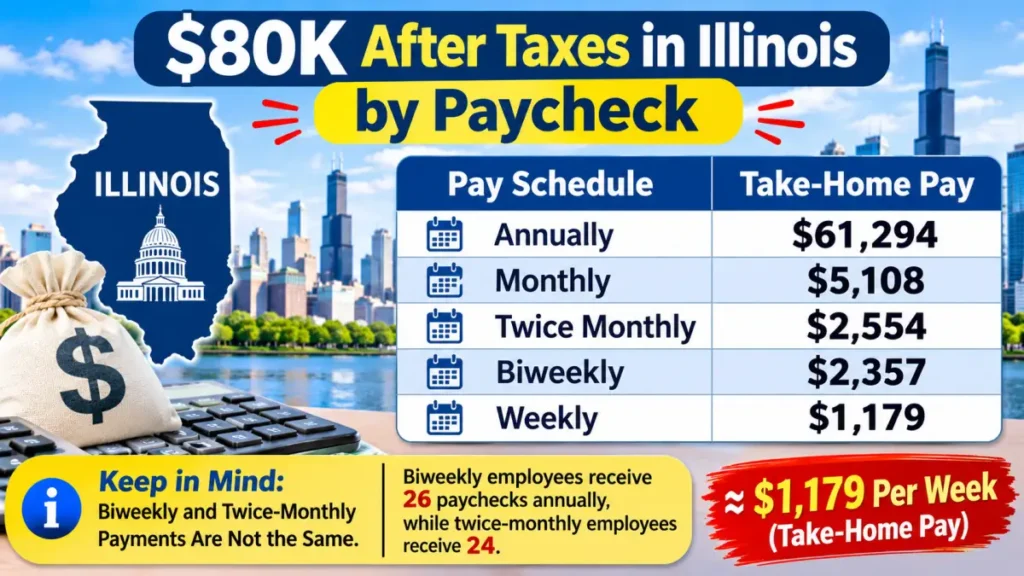
$80K After Taxes in Illinois by Paycheck
Your take-home pay also depends on how frequently your employer pays you. Some companies pay employees weekly, while others use biweekly or twice-monthly schedules.
Here’s an estimated breakdown:
| Pay schedule | Take-home pay |
| Annually | $61,294 |
| Monthly | $5,108 |
| Twice monthly | $2,554 |
| Biweekly | $2,357 |
| Weekly | $1,179 |
Keep in mind that biweekly and twice-monthly payments are not the same. Biweekly employees receive 26 paychecks annually, whereas twice-monthly employees receive 24.
What Taxes Are Deducted From an $80K Salary in Illinois?
There are four main taxes to understand when calculating your take-home pay.
1. Federal Income Tax
Federal income tax is based on progressive tax brackets. This means different portions of your income are taxed at different rates.
For 2026, a single taxpayer receives a federal standard deduction of $16,100. Your taxable income is therefore lower than your full $80,000 salary.
2. Illinois State Income Tax
Illinois uses a flat individual income tax rate of 4.95%. Unlike states with progressive income tax brackets, Illinois applies the same rate to taxable income regardless of how much you earn.
The state also provides a personal exemption. For 2026, the standard exemption is $2,925 for an eligible individual.
3. Social Security Tax
Social Security takes 6.2% of your eligible wages. On an $80,000 salary, that’s approximately $4,960 annually.
4. Medicare Tax
Medicare generally takes 1.45% of your wages. For someone earning $80,000, this comes to approximately $1,160 per year.
Together, Social Security and Medicare account for $6,120 in estimated annual payroll taxes. If you’re planning for long-term financial security, use our Ramsey Retirement Calculator to estimate your retirement savings and understand how your current income can support your future goals.

Is $80K a Good Salary in Illinois?
For many individuals, $80,000 is a reasonable salary in Illinois. Whether it feels comfortable depends largely on where you live and your financial responsibilities.
Someone living outside Chicago with affordable housing and limited debt may have more room to save. On the other hand, someone renting an apartment in downtown Chicago, paying student loans, and supporting a family may find the same salary more challenging.
Your lifestyle, housing costs, transportation, and health insurance can make a significant difference.
How Can You Increase Your Take-Home Pay?
There are a few practical ways to manage your income more effectively.
- Review your W-4: Make sure your federal withholding information is accurate.
- Consider a 401(k): Traditional pre-tax retirement contributions can reduce your taxable income.
- Check your health benefits: Employer-sponsored health insurance and eligible pre-tax benefits can affect your paycheck.
- Track monthly expenses: Knowing where your money goes makes it easier to build savings.
- Review your tax situation: Eligible deductions and credits may reduce your overall tax liability.
Frequently Asked Questions
How much is $80K after taxes in Illinois per month?
An $80,000 salary leaves approximately $5,108 per month after estimated federal, state, and payroll taxes for a single filer in 2026.
How much is $80K biweekly after taxes in Illinois?
You can expect approximately $2,357 every two weeks, assuming 26 paychecks per year and no additional payroll deductions.
How much tax do you pay on $80K in Illinois?
Estimated total annual taxes are approximately $18,705, including federal income tax, Illinois income tax, Social Security, and Medicare.
Does Illinois have a flat income tax?
Yes. Illinois has a flat individual income tax rate of 4.95%. The rate does not increase as your income rises.
Is $80K enough to live comfortably in Illinois?
It can be enough for a comfortable lifestyle, particularly for someone living alone without significant debt. Housing costs, family size, and personal spending habits determine how far your income will go.
Final Thoughts
An $80,000 salary in Illinois gives you approximately $61,295 in annual take-home pay in 2026, or around $5,108 per month. That’s a useful starting point when planning your budget or evaluating a job offer.
Just remember that your actual paycheck may be different because of your filing status, retirement contributions, insurance premiums, and other deductions. Understanding these numbers before making financial decisions can help you manage your income with greater confidence.