Velocity banking is a debt-payoff strategy that typically uses a home equity line of credit (HELOC) to accelerate repayment of a mortgage or other debt. It can reduce interest in some situations, but it is not a guaranteed shortcut to becoming debt-free.
This guide explains what velocity banking is, how the strategy works, how to evaluate it with a velocity banking calculator, and when the risks may outweigh the potential benefits.
What Is Velocity Banking?
Velocity banking is a cash-flow and debt-management strategy rather than a special bank account or government-recognized financial product.
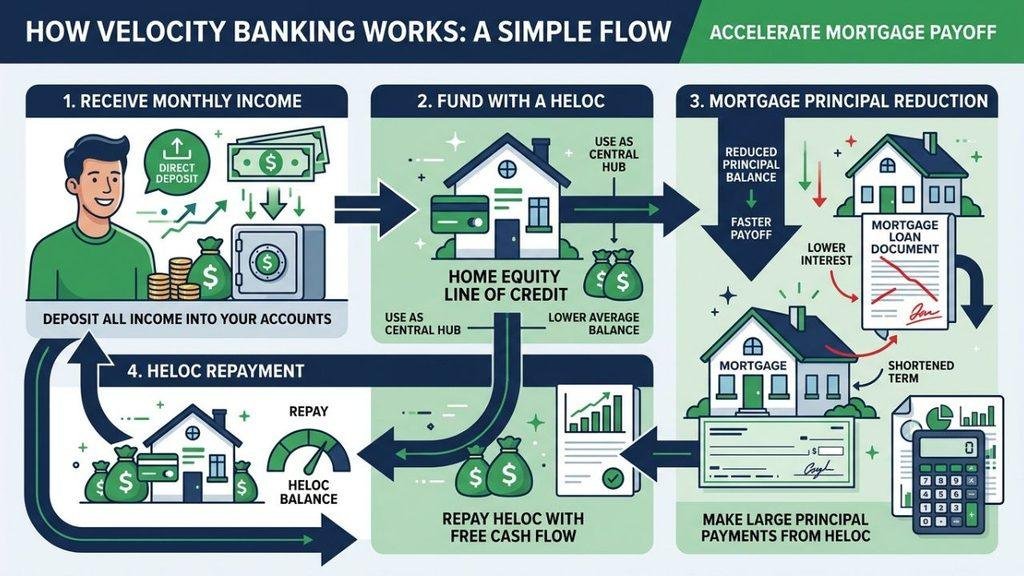
The most common version uses a HELOC secured by the borrower’s home. A borrower draws money from the HELOC, applies it toward a mortgage or other debt, and then directs income toward reducing the HELOC balance. Once the line is paid down, the process may be repeated.
The strategy is based on a simple financial principle: reducing debt earlier can reduce future interest costs.
A HELOC works differently from a traditional installment loan. It is a revolving credit line secured by home equity, allowing the borrower to draw, repay, and potentially borrow again during the draw period. The Consumer Financial Protection Bureau (CFPB) says HELOCs usually have adjustable interest rates, meaning payments can change as rates change.
That makes velocity banking more complicated than simply making extra mortgage payments.
How Does Velocity Banking Work?
The basic process is:
- Open a HELOC or another suitable revolving credit line.
- Draw a planned amount from the line.
- Use that money to reduce the principal on another debt.
- Deposit your income toward the HELOC.
- Use your remaining cash flow for normal expenses.
- Continue paying down the HELOC balance.
- Repeat only if the numbers still make financial sense.
For example, imagine a homeowner has a $250,000 mortgage and a genuine monthly surplus of $2,500 after normal expenses.
A velocity-banking strategy might involve borrowing $20,000 from a HELOC and applying it directly to the mortgage principal. The mortgage balance falls, but the HELOC balance rises by $20,000.
The homeowner then uses the $2,500 monthly surplus to reduce the HELOC.
The important point is that the $20,000 of debt has not disappeared. It has moved from one loan to another.
Some velocity-banking systems also recommend directing paychecks into the HELOC and using the line for expenses. The logic is that reducing the balance sooner may reduce interest on a revolving line. But this approach requires careful budgeting and an understanding of how the lender calculates interest.
Velocity banking therefore depends heavily on cash-flow discipline, not simply access to a large credit line.
Why Can Velocity Banking Save Interest?
The potential savings come from reducing the balance on which interest is charged.
Suppose a borrower owes $20,000 at a 10% annual rate. A simplified one-year calculation would produce about $2,000 of interest if the balance remained unchanged throughout the year.
If the balance is paid down substantially during the year, less interest would generally accrue.
But velocity banking introduces a second loan. If the original debt has a lower interest rate than the HELOC, moving the balance could actually increase borrowing costs.
For that reason, comparing interest rates alone is not enough.
You need to compare:
- Interest rates
- Average balances
- Repayment speed
- HELOC fees
- Mortgage amortization
- Monthly cash flow
- Potential rate increases
- Taxes where applicable
- The risk of losing access to the credit line
A strategy that looks attractive at one interest rate can become unattractive after a rate increase or unexpected expense.
Is Velocity Banking a Good Idea?
Velocity banking can be useful for borrowers with strong cash flow and disciplined spending, but it is not automatically better than making extra payments on existing debt.
It may be worth investigating if you have:
- Stable income
- Significant home equity
- A consistent monthly surplus
- A competitive HELOC rate
- Low or manageable HELOC fees
- A fully funded emergency reserve
- A clear plan for repaying the HELOC
It may be a poor choice if your budget is already stretched, your income is uncertain, or you would need the HELOC to pay ordinary living expenses.
The biggest concern is that your home secures a HELOC. The CFPB specifically warns that borrowers who cannot repay a HELOC could lose their home.
That makes velocity banking fundamentally different from simply putting extra money toward a mortgage.
Do You Need High Income for Velocity Banking?
No. You do not need a high income, but you do need reliable positive cash flow.
A person earning $120,000 per year may have little money available for accelerated debt repayment if expenses consume most of the income.
Meanwhile, someone earning $60,000 might have a meaningful surplus because housing and other costs are lower.
The critical figure is therefore:
Take-home income − essential expenses − required debt payments = available cash flow
For example:
Monthly Cash Flow Example
Take-home income $7,000
Household expenses $4,800
Required debt payments $900
Available surplus $1,300
In this hypothetical example, the borrower has approximately $1,300 available for accelerated debt repayment.
That figure matters much more than the person’s annual salary.
A borrower should also avoid treating every dollar of surplus as available for debt. Unexpected medical bills, home repairs, insurance increases, and job interruptions can quickly change a household budget.
Velocity Banking vs. Extra Mortgage Payments
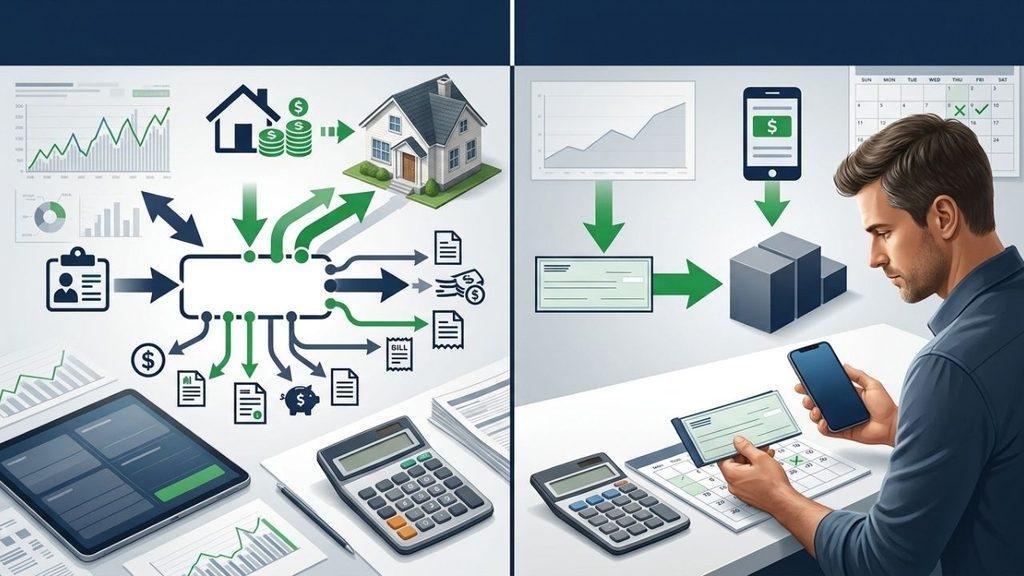
For many homeowners, the most important comparison is not velocity banking versus doing nothing. It is velocity banking versus simply making extra mortgage payments.
Feature Velocity Banking Extra Mortgage Payments
Main tool Usually a HELOC Existing mortgage
Adds another loan? Yes No
Interest-rate risk Usually higher Depends on existing mortgage
Complexity Higher Low
Potential fees HELOC fees may apply Usually limited
Home collateral Yes for HELOC Existing mortgage already secured
Cash-flow discipline Very high Moderate
Main attraction Potentially faster debt reduction Simple and predictable
If you have $1,500 of extra cash each month, you can potentially send that amount directly toward mortgage principal.
That approach does not require a new credit application, a second interest rate, or another revolving balance.
Velocity banking can still have a mathematical advantage in certain circumstances, particularly when the revolving credit line and cash-flow pattern make the strategy efficient. But the advantage must be demonstrated with actual numbers.
Effective Bank Communication Management can help financial institutions improve customer communication, manage important updates, and maintain consistent messaging.
Velocity Banking Calculator: What Should You Enter?
A velocity banking calculator can help estimate whether the strategy makes sense, but the quality of the result depends entirely on the assumptions entered.
At minimum, a useful calculator should consider:
- Current mortgage balance
- Mortgage interest rate
- Remaining loan term
- Current monthly payment
- HELOC interest rate
- HELOC credit limit
- Planned HELOC draw
- HELOC fees
- Monthly income
- Monthly expenses
- Extra monthly cash flow
- Expected repayment period
Some velocity-banking calculators also produce a projected payoff schedule and estimated interest savings. The calculator offered by FirstLienHELOC, for example, is designed around inputs such as loan balance and cash flow and can generate a paydown schedule and estimated cost savings.
However, a calculator should be treated as a scenario tool, not a promise.
The result can change substantially if the HELOC rate increases, your income falls, expenses rise, or you borrow more than planned.

How to Evaluate a Velocity Banking Calculator
Don’t look only at the projected payoff date.
Run at least three scenarios:
Scenario 1: Keep the Existing Mortgage
Continue making the required mortgage payment.
Scenario 2: Make Extra Mortgage Payments
Use your monthly surplus to reduce mortgage principal directly.
Scenario 3: Use Velocity Banking
Include the HELOC draw, HELOC rate, fees, and actual monthly repayment plan.
Then compare the total interest and fees in each scenario.
A good analysis should also include a stress test.
For example:
- What if the HELOC rate rises by 2 percentage points?
- What if monthly surplus falls by 25%?
- What if a major home repair costs $8,000?
- What if the lender reduces or freezes the available credit?
- What happens when the HELOC enters its repayment period?
The CFPB notes that a lender may freeze or reduce a HELOC in certain circumstances, including significant changes in home value or the borrower’s financial situation.
A Simple Hypothetical Example
Consider a homeowner with:
- Mortgage balance: $200,000
- Mortgage rate: 6.5%
- HELOC balance used: $20,000
- Hypothetical HELOC rate: 8%
- Monthly surplus: $2,000
The homeowner uses the $20,000 HELOC draw to reduce the mortgage.
At first glance, the mortgage balance has fallen by $20,000. But the household still owes $20,000 on the HELOC.
The borrower then uses the $2,000 monthly surplus to pay down the HELOC.
Ignoring interest and fees for simplicity:
$20,000 ÷ $2,000 = 10 months
So the borrower would need about 10 months of $2,000 monthly surplus to repay the original HELOC draw.
In reality, interest would make the payoff take longer or require a larger payment.
This example demonstrates why velocity banking is not “free money.” The strategy only works if the household has sufficient cash surplus to quickly reduce the new debt.

The Biggest Risks of Velocity Banking
Variable Interest Rates
HELOCs commonly have variable rates. The CFPB explains that payments can change as the underlying rate changes.
If the HELOC rate rises significantly, the expected interest savings can shrink or disappear.
Your Home Is Collateral
This is the most important risk.
A HELOC is secured by home equity. If the borrower cannot keep up with payments, the consequences can be far more serious than those of simply carrying unsecured debt.
Fees Can Reduce Savings
Depending on the lender and agreement, a HELOC can involve application, appraisal, annual, transaction or other charges.
The CFPB recommends comparing HELOC offers and examining items such as the credit limit, interest rate, index, margin, rate adjustments, draw period, repayment period and fees.
Borrowing Can Become a Habit
A credit line can create a dangerous psychological trap.
If you use the HELOC to pay down the mortgage and then use the newly available credit to finance vacations, vehicles or everyday spending, the strategy stops being a debt-reduction system.
You are simply moving debt around.
Emergency Savings May Be Overlooked
Some velocity-banking approaches emphasize using available cash to reduce debt rather than holding large cash reserves.
That can be risky.
An emergency fund provides liquidity without requiring another loan. A HELOC should not be automatically treated as a replacement for cash savings, as the lender may restrict access to the line.
Can Velocity Banking Pay Off $10,000 Debt in 6 Months?
Yes, if you can consistently generate enough cash flow to repay about $10,000 plus interest and fees within six months.
Ignoring interest:
$10,000 ÷ 6 = $1,666.67 per month
You would need at least $1,667 per month of available cash flow.
With interest, the required payment would be higher.
For example, at a hypothetical 20% annual interest rate, the payment needed to amortize $10,000 over six months would be roughly $1,754 per month, depending on the exact calculation method.
The lesson is simple: the debt has to be repaid with real cash flow. Changing the account used to hold the debt does not create additional income.
What Are the Advantages of Velocity Banking?
Potential advantages include:
- Faster principal reduction when cash flow is strong
- Potential interest savings
- A structured focus on household cash flow
- The ability to attack large debts with lump-sum payments
- Greater awareness of where monthly income is going
Velocity banking can also encourage borrowers to focus on debt reduction rather than simply making minimum payments.
However, these advantages depend on execution. The HELOC itself does not produce the savings. The borrower’s cash flow, interest rates, and repayment behavior do.
What Are the Disadvantages?
The main disadvantages are:
- Variable HELOC interest rates
- Additional debt
- Potential lender fees
- Higher financial complexity
- Risk of overborrowing
- Dependence on stable income
- Possible loss of home if secured debt cannot be repaid
- Potential reduction or freeze of the available credit line
The strategy also requires more active financial management than ordinary mortgage prepayments.
For someone who prefers simplicity, the added complexity may not be worth a relatively small potential saving.
What Is “Velocity Bank”?
The phrase velocity bank can be misleading.
Velocity banking is generally a financial strategy, not the name of one standardized bank account or banking institution. Different companies may use similar terminology when marketing HELOCs, calculators, coaching, or debt-management services.
Consumers should therefore evaluate the actual financial product rather than relying on the label.
Look at the loan agreement and compare:
- APR
- Variable-rate formula
- Credit limit
- Fees
- Draw period
- Repayment period
- Minimum payments
- Rate caps
- Early-termination terms
A strategy’s name does not determine whether the underlying loan is a good deal.
Velocity Banking Explained in Simple Terms
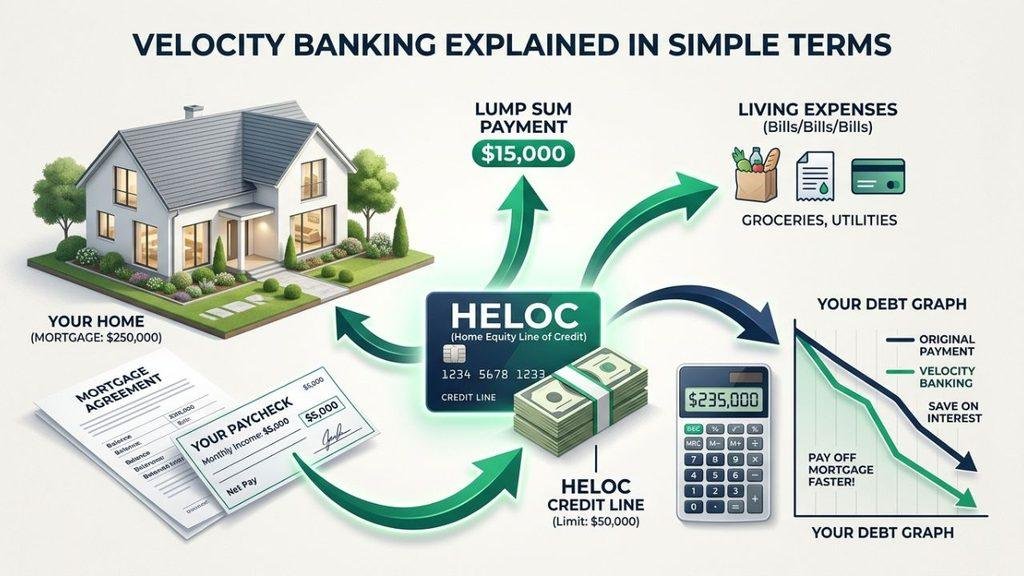
Think of velocity banking as moving debt to a revolving credit line and trying to pay that line down quickly with your income.
The possible benefit comes from reducing debt sooner and potentially paying less interest.
The risk comes from replacing or supplementing one loan with another, often at a variable rate and with your home securing the HELOC.
There is no new money created. Your financial results still depend on how much money comes into your household, how much goes out, and how quickly you reduce your debt.
When Should You Avoid Velocity Banking?
You should be particularly cautious if:
- Your income is unstable.
- You have little emergency savings.
- You regularly rely on credit cards for basic expenses.
- Your monthly budget has little or no surplus.
- The HELOC rate is higher than the rate on the debt you want to replace.
- The HELOC has substantial fees.
- You are uncomfortable using your home as collateral.
- You are relying on optimistic future income.
- You have not compared the strategy with simple extra payments.
In these situations, reducing spending, building emergency savings, paying down high-interest debt, or making direct extra payments may be more appropriate.
Frequently Asked Questions
1. What is velocity banking?
Velocity banking is a debt payoff strategy that typically uses a HELOC to make larger payments toward another debt, followed by aggressive repayment of the HELOC.
2. Is velocity banking a good idea?
It can be useful for borrowers with stable income, strong cash flow, and favorable HELOC terms. It is not suitable for everyone.
3. Do you need high income for velocity banking?
No. You need reliable monthly surplus cash flow more than a high income. Your budget determines how quickly you can repay the HELOC.
4. Does velocity banking really save money?
It can, but savings depend on interest rates, fees, repayment speed, and cash flow. A calculator should compare it with simply making extra debt payments.
5. What is the biggest risk of velocity banking?
The biggest risk is that your home typically secures a HELOC. If you cannot repay the debt, you could put your home at risk.
Conclusion
Velocity banking can be a useful debt-management strategy when the numbers genuinely support it. However, it is not a shortcut that eliminates debt or guarantees interest savings.
Before using a HELOC, compare its rate, fees, repayment terms, and risks to those of simply making extra payments on your existing debt. A strong monthly surplus, emergency savings, and disciplined spending are essential.
The best strategy is not necessarily the most complicated one. Choose the approach that reduces your debt while keeping your finances manageable and your financial risks under control.
Pingback: Personal Financial Management: Simple Ways to Take Control of Your Money