Unused FSA money usually goes back to your employer when the plan year ends if you haven’t spent it. However, you may be able to keep some of your balance through an FSA rollover or use it during an employer-provided grace period.
If you have money left in your Flexible Spending Account (FSA), understanding your plan’s deadlines can help you avoid losing those funds. Here is what happens to unused money, how rollover rules work, and what you can do before your spending deadline. Planning your healthcare expenses ahead of time can help you avoid wasting money. Following a simple monthly budgeting strategy can also make it easier to manage your regular expenses.
What Is an FSA and How Does It Work?
A Flexible Spending Account (FSA) is an employer-sponsored benefit that allows employees to set aside money from their paychecks before taxes to cover eligible healthcare expenses.
You can use these funds for qualifying costs such as prescription medications, medical copayments, dental treatments, eye exams, and eligible medical supplies.
During your employer’s open enrollment period, you decide how much money to contribute for the upcoming plan year. Because contributions are generally deducted before taxes, an FSA can help reduce your taxable income while making healthcare expenses more manageable.
However, there is one important rule: you should not assume that unused money will remain in your account forever.

What Happens to Unused FSA Money at the End of the Year?
Most healthcare FSAs follow a rule commonly known as “use it or lose it.” This means you generally need to spend your available balance on eligible expenses before your plan’s deadline.
If you do not use the money and your employer does not offer a rollover or grace period, the remaining balance is forfeited.
The unused money generally returns to your employer rather than being paid directly to you. Employers may use forfeited funds for permitted plan-related expenses and other purposes allowed under applicable rules.
For example, imagine you contributed $2,000 to your FSA during the year but used only $1,500. If your plan does not offer a rollover or grace period, the remaining $500 could be lost.
That is why checking your plan’s specific rules before the end of the year is important. If you want to understand whether your remaining balance can carry over, read our guide on FSA moneyrolls over to the next year to learn more about rollover rules and what happens to unused funds.
Does Unused FSA Money Roll Over to the Next Year?
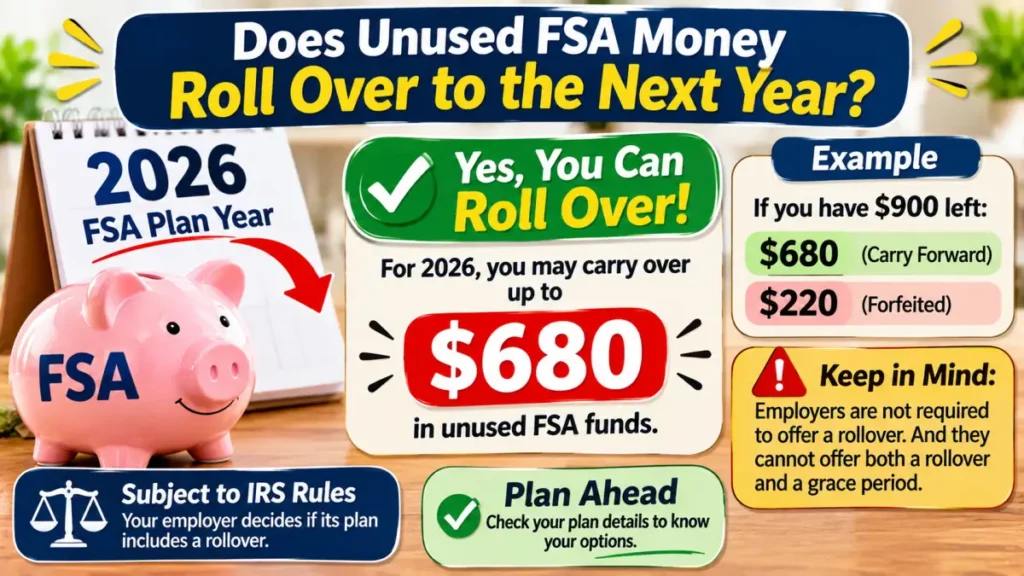
Yes, some unused FSA money can roll over, but it depends on your employer’s plan.
For the 2026 plan year, employers may allow eligible employees to carry over up to $680 in unused healthcare FSA funds into the following plan year.
However, employers are not required to offer this option. Your company decides whether its plan includes a rollover, subject to IRS requirements.
For example, if you have $900 left in your FSA and your employer offers the maximum permitted rollover, up to $680 may carry forward. The remaining $220 would generally be forfeited.
It is also important to understand that an employer cannot offer both the standard rollover and the grace period for the same healthcare FSA plan year.
What Is the Difference Between an FSA Rollover and a Grace Period?
An FSA rollover and a grace period both give you extra time to use leftover money, but they work differently.
FSA rollover: Your employer allows a certain amount of unused money to move into the next plan year. You can then use those funds for eligible healthcare expenses during the new year.
FSA grace period: Your employer gives you additional time after the plan year ends to spend your remaining balance. This period can last up to 2½ months, depending on your plan.
For example, if your FSA year ends on December 31, a maximum grace period could extend through March 15 of the following year.
Remember, your employer generally must choose between offering a rollover or a grace period for a healthcare FSA. Good financial planning involves more than managing healthcare costs. Developing better saving habits can also help you prepare for future financial needs.
What Is an FSA Run-Out Period?
A run-out period is another important feature that many employees misunderstand.
It gives you extra time to submit reimbursement claims for eligible medical expenses you already incurred during the previous plan year.
For example, suppose you visited a dentist in December but forgot to submit your reimbursement request. If your employer provides a run-out period until March 31, you may still submit that claim before the deadline.
However, a run-out period does not allow you to make new medical purchases using your previous year’s balance. It only gives you more time to submit existing claims.
How Can You Avoid Losing Unused FSA Money?
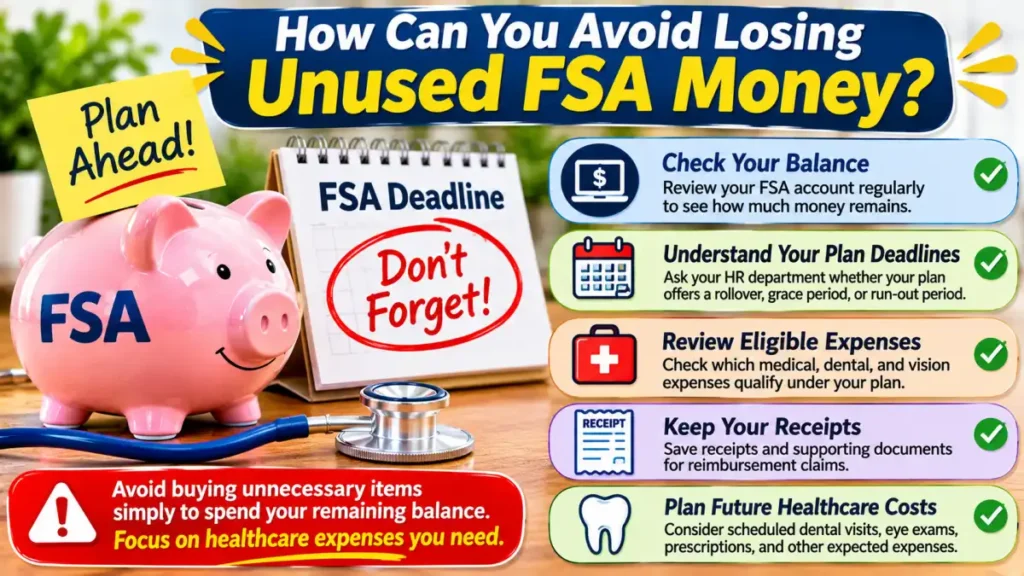
The best way to protect your FSA balance is to plan your healthcare spending before the deadline arrives.
Here are some practical steps:
- Check your balance: Review your FSA account regularly to see how much money remains.
- Understand your plan deadlines: Ask your HR department whether your plan offers a rollover, grace period, or run-out period.
- Review eligible expenses: Check which medical, dental, and vision expenses qualify under your plan.
- Keep your receipts: Save receipts and supporting documents for reimbursement claims.
- Plan future healthcare costs: Consider scheduled dental visits, eye exams, prescriptions, and other expected medical expenses.
Avoid buying unnecessary items simply to spend your remaining balance. Focus on healthcare expenses you actually need.
What Happens to FSA Money If You Leave Your Job?
Leaving your employer can also affect your FSA balance.
Unlike a Health Savings Account (HSA), a healthcare FSA generally does not belong to you permanently. It is connected to your employer’s benefit plan.
If you resign, retire, or lose your job, your access to unused FSA funds may end. However, certain circumstances may allow continued coverage through COBRA.
The rules depend on your plan, employment situation, and applicable eligibility requirements. Contact your benefits administrator before your employment ends to understand your options.
Frequently Asked Questions About Unused FSA Money
Do you lose unused FSA money at the end of the year?
Generally, yes. If your employer does not offer a rollover or grace period, unused money is forfeited after the applicable deadline.
Can I get my unused FSA money back in cash?
No. You generally cannot withdraw unused FSA funds as cash or receive them as a direct payment. They must be used according to your plan’s rules.
How much FSA money can roll over in 2026?
For the 2026 plan year, employers may allow up to $680 in unused healthcare FSA funds to carry over into the following plan year.
Can unused FSA money roll over every year?
It can, if your employer’s plan permits carryovers. Eligible balances may continue rolling over, subject to the applicable annual limits and plan rules.
Does an FSA balance expire if I do not use it?
Yes. Unless your plan offers an applicable rollover or grace period, unused funds are generally forfeited after the plan deadline.
Final Thoughts
Unused FSA money does not always disappear at the end of the year, but you should never assume it will automatically roll over. Your employer’s plan determines whether you get a carryover, grace period, or additional time to submit reimbursement claims.
Check your account balance, understand your deadlines, and plan your eligible healthcare expenses carefully. A little preparation can help you make the most of your FSA money and avoid losing funds you worked hard to save.
Pingback: High-Yield Savings Account Rates Today: What Savers Need to Know - finexaia.com