Finding the best high-yield savings account rates can help you earn more interest while keeping your money accessible. In November 2026, some competitive U.S. savings accounts are advertising annual percentage yields (APYs) above 4%, giving savers an opportunity to grow their money faster than they might in traditional savings accounts.
Whether you’re building an emergency fund, saving for a home, planning a major purchase, or simply looking for a better place to keep your cash, choosing the right savings account can make a meaningful difference.
However, the highest advertised APY isn’t always the best option. Some banks require minimum balances, qualifying monthly deposits, or promotional enrollment to receive their top rates.
In this guide, we’ll compare current high-yield savings account rates, explain how APY works, calculate potential interest earnings, and discuss what to consider before opening an account.
Understanding your employee benefits can help you avoid losing valuable savings. Learn what happens to unused FSA money and discover important rules about spending deadlines, rollover options, and eligible expenses.
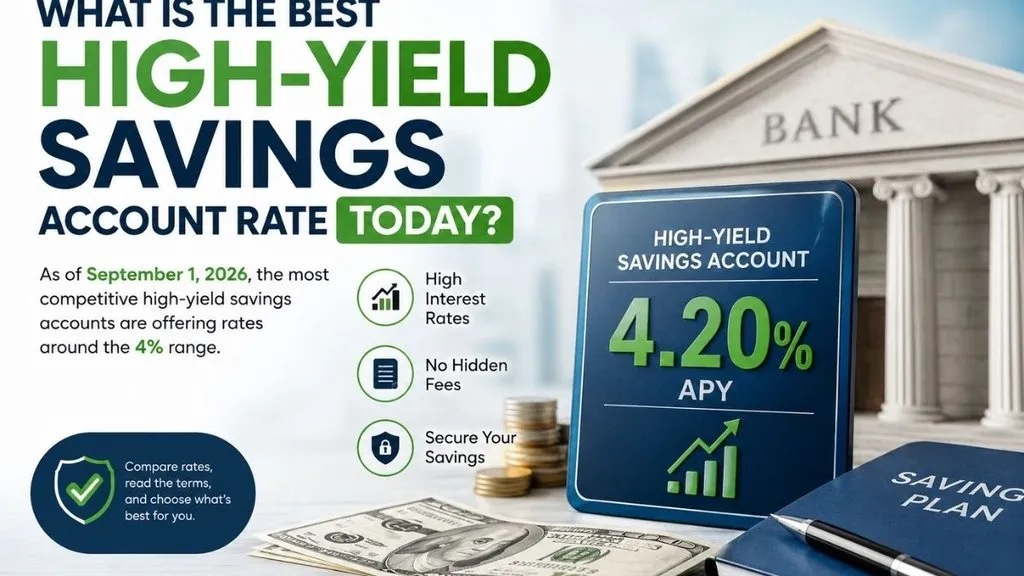
Best High-Yield Savings Account Rates in November 2026
As of November 10, 2026, competitive high-yield savings accounts are offering rates ranging from approximately 3.90% to 4.35% APY among the leading offers reported by Bankrate.
The highest advertised rate in its comparison is 4.35% APY, although some offers have promotional conditions or balance requirements.
Here is a comparison of selected savings accounts:
| Bank or financial institution | Advertised APY | Opening deposit or conditions |
|---|---|---|
| CIT Bank | Up to 4.35% | $100 opening deposit; promotional offer and $5,000 balance requirement for the top rate |
| Peak Bank | 4.27% | $100 opening deposit |
| Happen Bank | 4.20% | $250 monthly qualifying deposits for the highest rate |
| EverBank | 4.20% | No opening deposit minimum |
| Western State Bank | 4.20% | $1,000 opening deposit |
| Accordia Bank | 4.10% | $100 opening deposit |
| Bread Savings | 4.05% | $100 opening deposit |
| Vio Bank | 4.01% | $100 opening deposit |
| Live Oak Bank | 4.00% | No opening deposit minimum |
Rate information verified against Bankrate’s November 10, 2026 comparison.
These rates are subject to change. Opening deposits, minimum balances required to earn the advertised APY, promotional periods, and other eligibility conditions are not necessarily the same. Review each bank’s official account disclosure before applying.
What Is a High-Yield Savings Account?
A high-yield savings account is a type of deposit account that pays interest on the money you keep in it.
It works similarly to a traditional savings account, but it generally offers a higher annual percentage yield.
Many high-yield savings accounts are provided by online banks, which may have lower operating costs than traditional banks with extensive physical branch networks.
These accounts can be useful for people who want to earn interest without exposing their savings to the daily fluctuations of the stock market.
Common reasons to open a high-yield savings account include:
- Building an emergency fund.
- Saving for a house or vehicle.
- Keeping money for upcoming expenses.
- Saving for travel or education.
- Earning interest on money that is not needed immediately.
- Separating short-term savings from everyday spending.
A high-yield savings account is generally designed for saving rather than everyday transactions. Some accounts offer convenient electronic transfers, while others may have fewer withdrawal and payment features.
What Does APY Mean?
APY stands for Annual Percentage Yield. It represents the amount of interest an account can earn over one year, including the effect of compounding.
For example, if you deposit $10,000 into an account offering 4.00% APY and leave the money untouched for one year, you could earn approximately $400 in interest.
APY is useful when comparing savings accounts because it provides a standardized way to understand the potential annual return.
However, savings account APYs are usually variable. This means the bank can increase or decrease the rate depending on market conditions and its own policies.
Before opening an account, check whether the advertised APY is:
- A standard ongoing rate.
- A limited-time promotional rate.
- Available only after meeting certain requirements.
- Limited to a specific account balance.
Understanding these details helps prevent surprises after opening an account.
How Much Interest Can You Earn With a High-Yield Savings Account?
The amount of interest you earn depends on your deposit balance, APY, time in the account, and any changes in the interest rate.
To understand the potential benefit, consider the following examples using a 4.00% APY.
| Savings balance | Approximate annual interest | Balance after one year |
|---|---|---|
| $1,000 | $40 | $1,040 |
| $5,000 | $200 | $5,200 |
| $10,000 | $400 | $10,400 |
| $15,000 | $600 | $15,600 |
| $25,000 | $1,000 | $26,000 |
| $50,000 | $2,000 | $52,000 |
| $100,000 | $4,000 | $104,000 |
These are illustrative calculations assuming the APY remains unchanged for the entire year, no withdrawals or additional deposits occur, and there are no fees.
Your actual earnings may differ. Stay informed about changes to retirement benefits and government assistance programs. Read our latest guide to the Social Security COLA 2027 to discover the confirmed 3.6% increase, updated payment amounts, and payment dates.
How Much Will $10,000 Earn at 4.35% APY?
If you deposit $10,000 into an account paying 4.35% APY and maintain that rate for a full year, you could earn approximately $435 in interest.
Your estimated balance would become $10,435.
The same deposit at 3.00% APY would generate approximately $300 in annual interest.
That represents a difference of approximately $135 over one year.
This example shows why comparing APYs can be worthwhile, especially when you have a larger savings balance.
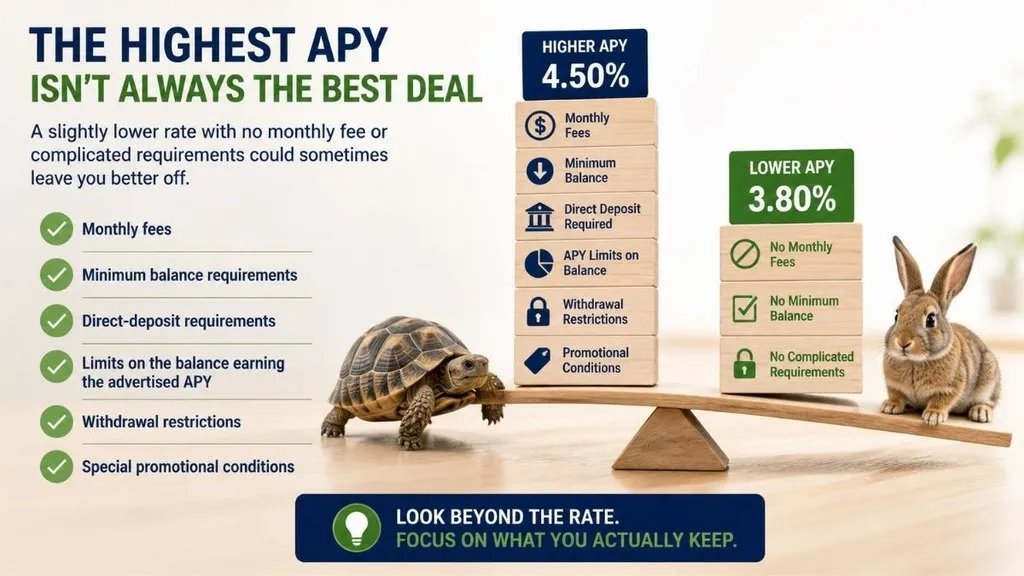
The Highest APY Isn’t Always the Best Deal
It’s easy to see a big number and immediately think you’ve found the perfect savings account. But there’s more to consider.
Check whether the account has:
- Monthly fees
- Minimum balance requirements
- Direct-deposit requirements
- Limits on the balance earning the advertised APY
- Withdrawal restrictions
- Special promotional conditions
A slightly lower rate with no monthly fee or complicated requirements could sometimes leave you better off.
High-Yield Savings Account vs. Traditional Savings Account
One of the biggest reasons people choose high-yield savings accounts is the opportunity to earn more interest.
Traditional savings accounts at large banks may offer relatively low APYs, while some online savings accounts provide significantly higher rates.
Consider this comparison using illustrative interest rates:
| Feature | Traditional savings account | High-yield savings account |
|---|---|---|
| Interest rate | Often lower | Often higher |
| Accessibility | Usually convenient | Usually available through online transfers |
| Monthly fees | Depends on bank | Many offer no monthly fee |
| Minimum balance | Depends on account | Depends on account |
| Online banking | Usually available | Usually available |
| Deposit insurance | FDIC or NCUA, where applicable | FDIC or NCUA, where applicable |
For example, suppose you deposit $10,000 into two different accounts:
- Traditional savings account at 0.50% APY: approximately $50 in annual interest.
- High-yield savings account at 4.00% APY: approximately $400 in annual interest.
The difference is approximately $350 over one year, assuming both rates remain unchanged.
A higher rate can therefore make a noticeable difference over time.
Keep an Eye on Your Rate
One thing many savers forget is that savings account rates can change.
The APY you receive today isn’t necessarily the rate you’ll receive six months from now. Banks can adjust their rates as economic and interest-rate conditions change.
That’s why it can be smart to check your account from time to time and compare it with other competitive options.
Is a High-Yield Savings Account Worth It?
For many people, yes. If you’re keeping a large amount of cash in savings, earning a competitive APY can help your money work harder without taking on the risks associated with market investments.
The key is not simply to chase the highest number. Look at the APY, fees, requirements, and accessibility together. If you choose a credit union, check whether your deposits are protected by NCUA share insurance
Frequently Asked Questions
1. What is a good high-yield savings account rate in November 2026?
Competitive high-yield savings accounts are offering approximately 4% APY or more in some cases. However, the best available rate depends on account requirements, promotional terms, and eligibility.
2. Which bank has the highest high-yield savings account rate?
Bankrate reported a leading advertised rate of 4.35% APY for CIT Bank on November 10, 2026. The offer has promotional conditions and a balance requirement for the top rate. Always verify current terms directly with the bank.
3. How much interest will $10,000 earn in a high-yield savings account?
At 4.00% APY, a $10,000 deposit could earn approximately $400 over one year, assuming the rate remains unchanged and there are no withdrawals or fees.
4. Are high-yield savings accounts FDIC-insured?
Eligible savings deposits at FDIC-insured banks are covered up to $250,000 per depositor, per insured bank, for each account ownership category. Check the institution’s insurance status before depositing money.
5. Can a high-yield savings account lose money?
A deposit in an appropriately insured savings account at an insured bank is protected within applicable FDIC limits against bank failure. However, fees, inflation, and other financial factors can affect your overall financial position.
Final Thoughts
A high-yield savings account can help you earn more interest while keeping your money relatively accessible.
In November 2026, some competitive U.S. savings accounts are advertising APYs above 4%, making it worthwhile for savers to compare their existing accounts with current market options.
However, the highest advertised rate is not automatically the best choice. Minimum balance requirements, monthly fees, promotional conditions, deposit insurance, and withdrawal options all matter.
Before opening an account, compare several institutions and read their official account disclosures carefully.
Whether you are building an emergency fund, saving for a major purchase, or organizing your retirement savings, choosing an account that fits your needs can help you make better financial decisions.
For more practical guides about saving, banking, and personal finance, continue exploring Finexaia.
Pingback: Personal Financial Management: Simple Ways to Take Control of Your Money